APA Citation: Staal, F. (1989). Rules without meaning: Ritual, mantras and the human sciences. New York: Peter Lang.
What the Book is About
Frits Staal’s Ritual and Mantras: Rules Without Meaning emerges from a long engagement with Vedic ritual practice, especially the Agnicayana fire ritual performed in South India. The work is not merely descriptive but polemical: it challenges deeply entrenched assumptions in philosophy, linguistics, anthropology, and religious studies about the nature of meaning, language, and human action. At its core lies a radical thesis—ritual and mantras are governed by rules but do not necessarily possess meaning in the semantic sense that modern thought assumes.
The book situates itself against a long intellectual tradition that privileges meaning as the central category for understanding human practices. In Western philosophy, especially after the influence of figures like Ludwig Wittgenstein and Martin Heidegger, meaning has been treated as the defining feature of language and culture. Staal’s intervention is to suggest that this emphasis is misplaced when it comes to ritual. Rituals, he argues, are not symbolic systems encoding meaning; rather, they are structured activities governed by precise syntactic rules, analogous more to grammar or mathematics than to discourse or narrative.
The empirical foundation of the book lies in Staal’s detailed observation of Vedic ritual traditions, particularly those preserved among Nambudiri Brahmins. These rituals exhibit extraordinary complexity and precision, often involving sequences of actions and recitations that are transmitted with remarkable fidelity across generations. Yet, paradoxically, participants themselves often cannot explain the “meaning” of what they are doing. This disconnect becomes the starting point for Staal’s broader theoretical claim: meaning is not intrinsic to ritual; it is an interpretive overlay imposed after the fact.
The book is divided into four major parts. The first lays out methodological and philosophical foundations, interrogating the concepts of meaning and rules. The second and third examine ritual and mantras respectively, drawing heavily on Vedic material. The fourth expands outward into the “human sciences,” attempting to reposition ritual within a broader scientific framework of human behavior. Throughout, Staal maintains that ritual and mantra traditions have been systematically misunderstood because scholars have insisted on interpreting them through categories—like symbolism, belief, and meaning—that are inappropriate to their actual structure.
This work is therefore not simply about Indian religion. It is an attempt to rethink the foundations of the human sciences themselves. By showing that complex, culturally central practices can exist without meaning, Staal challenges the assumption that meaning is the primary organizing principle of human life. Ritual, in his account, belongs to a different order—one governed by rule, form, and performance rather than interpretation.
Intellectual Framework
The intellectual framework of the book rests on a decisive separation between two concepts: meaning and rules. Staal argues that modern thought has conflated these, assuming that wherever there are structured human activities, there must also be meaning. His project is to disentangle them and show that rule-governed behavior can exist independently of semantic content.
The first move in this framework is methodological. Staal insists that ritual and mantras must be studied as empirical phenomena, not as expressions of belief or symbolic systems. This aligns his approach with the broader ambitions of the human sciences, particularly linguistics. Just as language can be analyzed in terms of syntax independent of semantics, so too can ritual be analyzed as a system of rules governing sequences of actions.
This analogy to linguistics is central. Drawing on developments associated with Noam Chomsky, Staal emphasizes that grammar operates according to formal rules that speakers may not consciously understand. Similarly, ritual participants may perform highly complex sequences without knowing their “meaning.” The competence lies in the correct execution of rules, not in semantic comprehension.
A second component of the framework is the critique of philosophical traditions that prioritize meaning. Staal engages with both analytic and continental philosophy, including Wittgensteinian language-games and hermeneutic approaches associated with Heidegger and Hans-Georg Gadamer. These traditions, despite their differences, share an assumption that meaning is central to human practices. Staal challenges this by presenting ritual as a counterexample: a domain where meaning is either absent or irrelevant.
The third element is a redefinition of ritual itself. Instead of viewing ritual as symbolic action (as in much anthropology), Staal defines it as pure activity governed by rules. Ritual is not something that represents or communicates; it is something that is done. Its significance lies in its structure and performance, not in any message it conveys.
This leads to one of the most provocative claims of the book: rituals are “rules without meaning.” This does not mean they are random or chaotic. On the contrary, they are often more rigorously structured than language itself. But their structure is not oriented toward conveying meaning; it is self-contained, operating according to its own internal logic.
Finally, Staal situates ritual within a broader biological and cognitive context. He suggests that ritualization may have roots in animal behavior, where patterned, rule-governed actions occur without symbolic meaning. This opens the possibility that ritual is a fundamental aspect of human (and even pre-human) behavior, rather than a derivative product of belief systems.
In sum, the intellectual framework of the book is both reductive and expansive. It reduces ritual to rule-governed activity, stripping away layers of interpretive meaning. At the same time, it expands the scope of inquiry, linking ritual to linguistics, biology, and the general study of human behavior. The result is a reorientation of how ritual—and by extension, culture itself—is to be understood.
Chapter 1: Meanings and Rules in the Human Sciences
The opening chapter of Staal’s work establishes the conceptual battlefield upon which the rest of the book unfolds. It is not yet about ritual in the empirical sense; rather, it interrogates the categories through which ritual has traditionally been understood—especially meaning. The chapter functions as a dismantling of a deeply ingrained assumption in the human sciences: that meaning is the primary lens through which all human activity must be interpreted.
Staal begins by situating the problem within the broader intellectual history of the human sciences. The dominant paradigm, inherited from both philosophy and linguistics, presumes that human practices are meaningful, and that understanding them consists in uncovering this meaning. This assumption is so pervasive that it often operates unconsciously. Ritual, myth, language, and even social practices are treated as systems of symbols that represent something—beliefs, values, cosmologies. The task of the scholar, accordingly, becomes one of interpretation: decoding what these practices signify.
However, Staal immediately destabilizes this framework by introducing a distinction between meaning and rules. These two concepts, though often conflated, belong to different domains. Meaning, he argues, is primarily a property of language—specifically of linguistic expressions that can be evaluated in terms of truth, reference, or semantic content. Rules, by contrast, govern the structure and execution of activities. They are not inherently tied to meaning; they can operate independently of it.
This distinction is not merely terminological but methodological. If ritual is approached as a system of meaning, then it will be analyzed in terms of symbolism, belief, and interpretation. If, however, it is approached as a system of rules, then it becomes analogous to grammar or formal systems—something that can be described in terms of structure, sequence, and transformation. Staal’s project is to shift the study of ritual from the former to the latter.
To prepare for this shift, the chapter undertakes a critique of empiricist and positivist conceptions of science. These traditions, which have influenced much of modern scholarship, tend to reduce knowledge to generalizations derived from observation. In this framework, meaning is often treated as something that can be empirically identified and analyzed. Staal argues that this view is a caricature of scientific method. Science, in practice, does not operate solely through induction or observation; it also involves the formulation of formal systems and rules that may not correspond directly to observable meaning.
This critique serves an important function. By undermining the assumption that all scientific inquiry must be grounded in observable meaning, Staal opens the possibility for a different kind of analysis—one that focuses on formal structures rather than semantic content. This is crucial for his later argument that ritual, like language, can be studied scientifically without being reduced to meaning.
The chapter then turns more directly to the concept of meaning itself. Drawing on developments in philosophy and linguistics, Staal emphasizes that meaning is not a universal property of all human activities. It is specifically tied to language, and even within language, not all expressions are meaningful. There exist linguistic forms—such as certain syntactic constructions or phonetic sequences—that are governed by rules but lack semantic content. This observation becomes a key analogy for understanding ritual and mantras.
If language can contain rule-governed structures that are meaningless, then it is plausible that ritual—another highly structured human activity—might also operate without meaning. The implication is subtle but far-reaching: the absence of meaning does not imply the absence of structure, order, or significance. It simply indicates that the framework of semantic interpretation is inadequate for capturing the phenomenon.
The concept of rules is then elaborated as the central analytical tool. Rules are not merely prescriptive (telling us what should be done); they are primarily descriptive (capturing patterns of behavior). In linguistics, rules describe how sentences are formed; in ritual, they describe how actions are performed. These rules can be highly complex and may be followed with great precision, even when their purpose or meaning is not understood by those who follow them.
This leads to an important epistemological insight: competence in a rule-governed system does not require awareness of the rules themselves. Just as speakers of a language can produce grammatically correct sentences without knowing the rules of grammar, ritual practitioners can perform complex rituals without understanding their “meaning.” The knowledge involved is procedural rather than semantic.
The chapter concludes by situating this approach within the broader domain of the human sciences. Staal suggests that ritual and mantras have been neglected not because they are unimportant, but because they have been approached with inappropriate conceptual tools. By insisting on meaning, scholars have overlooked the possibility that these phenomena belong to a different category—one defined by rules, performance, and structure rather than interpretation.
In effect, Chapter 1 lays the groundwork for the book’s central thesis. It dismantles the assumption that meaning is the key to understanding ritual and replaces it with a new framework centered on rules. This shift is not merely methodological but ontological: it redefines what ritual is. Instead of being a symbolic system that encodes meaning, ritual becomes a formal system of actions governed by rules—a system that can exist, persist, and be transmitted independently of any semantic content.
The implications of this redefinition will unfold gradually in the subsequent chapters, where Staal turns from conceptual analysis to empirical material. But already, the fundamental move has been made: ritual is no longer to be interpreted—it is to be analyzed.
Chapter 2: The Empiricist Caricature of Science
The second chapter deepens the methodological critique initiated in the first by turning directly to empiricism and its lingering influence on how knowledge—especially in the human sciences—is conceived. Staal’s concern here is not merely historical but diagnostic: he is identifying a distorted image of science that continues to shape scholarly approaches to ritual, meaning, and human behavior.
At the center of this critique is the empiricist doctrine that all knowledge derives from sense experience. This doctrine, inherited from early modern philosophy and refined through thinkers such as Hume and Mill, implies that general knowledge arises through induction—from repeated observation of particular instances. The scientific method, in this caricature, is imagined as a process of accumulating data and generalizing from it.
Staal calls this view a caricature because it captures only a narrow and misleading aspect of how science actually operates. It assumes that knowledge must always be grounded in observable phenomena and that general principles are merely summaries of empirical regularities. This assumption becomes particularly problematic when applied to domains such as language, ritual, or cognition, where the most significant structures are not directly observable.
The critique proceeds by exposing the limitations of induction itself. If general knowledge is derived from observed instances, then its validity is always contingent and uncertain. Philosophers have long recognized this problem: no amount of observed cases can guarantee the truth of a general statement. The classic problem of induction—famously articulated by Hume—remains unresolved. Staal invokes this tradition not to solve the problem but to show that reliance on induction as the foundation of scientific knowledge is untenable.
More subtly, he points out that even when induction appears to work, it depends on prior conceptual frameworks. Observations are never neutral; they are shaped by the categories and expectations we bring to them. What counts as a relevant instance, what is grouped together, what is considered similar—these are not given by experience itself but imposed by the mind. In this sense, the empiricist claim that knowledge is derived purely from observation collapses under its own weight.
This critique has direct consequences for the study of ritual. If scholars assume that rituals must be understood by observing their “meaning” in context—by identifying what they represent or signify—they are operating within this empiricist framework. They are treating ritual as a set of observable behaviors that can be interpreted through generalization. But if the framework itself is flawed, then the conclusions drawn from it are suspect.
Staal’s alternative is to emphasize the role of formal systems in scientific explanation. In many sciences, particularly mathematics and theoretical physics, knowledge is not derived from observation alone but from the construction of formal models governed by rules. These models may not correspond directly to observable reality, yet they provide powerful explanatory frameworks. The success of such approaches suggests that science is not limited to empiricism; it also involves abstraction, formalization, and the articulation of rule-governed systems.
This insight is crucial for his broader argument. Ritual, like language, may be better understood as a formal system rather than an empirical phenomenon to be interpreted. Its structure, sequence, and internal rules may be more significant than any supposed meaning it conveys. By clinging to the empiricist model, scholars risk overlooking these formal properties.
The chapter also addresses a common misconception: that abandoning empiricism entails abandoning science. Staal is careful to reject this implication. His critique is not anti-scientific; rather, it is an attempt to recover a more accurate understanding of scientific practice. Science, properly understood, is not confined to observation and induction. It includes the formulation of hypotheses, the construction of models, and the analysis of formal structures.
In this light, the study of ritual can be reimagined as a scientific enterprise—not by treating rituals as carriers of meaning, but by analyzing them as rule-governed systems. This approach aligns more closely with developments in linguistics, where the focus has shifted from meaning to structure, from semantics to syntax. Just as linguists study the rules that generate sentences, scholars of ritual can study the rules that generate ritual actions.
What emerges from this chapter is a methodological reorientation. The empiricist caricature of science has led scholars to prioritize meaning, interpretation, and observation. Staal argues that this orientation is not only limited but misleading. A more adequate approach recognizes the importance of formal systems and rules, even when they are not directly observable or semantically meaningful.
This reorientation prepares the ground for the next stage of the argument, where Staal will examine the concept of meaning itself more closely. Having shown that the empiricist framework is inadequate, he now turns to the question of whether meaning—so central to that framework—is even the right category for understanding ritual and mantras.
Chapter 3: The Positivist Critique of Meaning
In the third chapter, Staal turns from empiricism to positivism, addressing more directly the philosophical status of meaning itself. If the previous chapter dismantled the naïve belief that science is simply observation and induction, this chapter interrogates the equally pervasive belief that meaning is the fundamental unit of analysis in the human sciences. The critique now becomes sharper and more precise: it is not merely that meaning is overemphasized, but that its scope is often misunderstood.
Positivism, in its various forms, sought to ground knowledge in what can be verified. Statements that could not be empirically verified were often dismissed as meaningless. This led to a narrowing of what counted as meaningful language—only those expressions that could be linked to observable states of affairs were considered legitimate. While this movement had the virtue of clarity, it also introduced a rigid and ultimately unsustainable criterion for meaning.
Staal does not simply reject positivism; rather, he extracts from it a crucial insight while exposing its limitations. The insight is that not all linguistic expressions are meaningful. This is a decisive point. Language contains elements—sounds, repetitions, formal structures—that are governed by rules but do not convey semantic content. Meaning, therefore, is not coextensive with language. It is a subset, not the whole.
This observation becomes the pivot of the chapter. If language itself includes rule-governed but meaningless elements, then the assumption that all structured human activity must be meaningful collapses. The door is opened for considering ritual and mantras as analogous phenomena: structured, rule-governed, yet not necessarily meaningful.
To develop this argument, Staal engages with major philosophical figures, particularly Ludwig Wittgenstein and Martin Heidegger (along with Hans-Georg Gadamer). These thinkers represent different trajectories in twentieth-century philosophy, yet both are implicated in the broader question of meaning.
From Wittgenstein, especially in his later work, comes the idea that meaning is use—language gains its significance from the contexts in which it is employed. This shifts attention away from abstract definitions toward practical activity. However, Staal suggests that even this move does not fully escape the problem. By tying meaning to use, Wittgenstein still assumes that meaning is central, whereas Staal is questioning whether meaning is necessary at all.
Heidegger and Gadamer, associated with hermeneutics, take a different approach. They emphasize interpretation, understanding, and the historical situatedness of meaning. For them, human existence is fundamentally interpretive; we are always already engaged in making sense of the world. Ritual, within this framework, becomes a site of meaning—something to be interpreted in relation to culture, history, and existence.
Staal’s critique of this tradition is subtle but firm. Hermeneutics expands the domain of meaning rather than questioning it. It assumes that everything can be interpreted, that every practice encodes significance. But this assumption may be unwarranted. There may exist domains—such as ritual—where interpretation is not only unnecessary but misleading.
The chapter thus performs a double movement. On one hand, it acknowledges the contributions of positivism and hermeneutics in clarifying the concept of meaning. On the other, it shows that both traditions remain trapped within the same fundamental assumption: that meaning is indispensable. Staal’s project is to step outside this assumption altogether.
A key implication follows. If meaning is not universal, then the methodology of the human sciences must be reconsidered. Much of anthropology, religious studies, and philosophy has been devoted to interpreting meanings—symbols, beliefs, narratives. But if certain phenomena are not meaningful in this sense, then interpretive methods will fail to capture them. They will impose meanings where none exist, mistaking structure for symbolism.
This is precisely what Staal believes has happened in the study of ritual. Scholars have treated rituals as symbolic systems, searching for hidden meanings, decoding gestures and recitations as if they were texts. But this approach presupposes that rituals are meant to convey something. Staal’s emerging thesis is that this presupposition is false.
The chapter concludes, implicitly, by redefining the problem. The question is no longer “What do rituals mean?” but “How do rituals work?” This shift from meaning to function—from semantics to rules—marks a fundamental change in perspective. It aligns the study of ritual more closely with disciplines like linguistics and formal systems, where the focus is on structure and operation rather than interpretation.
In this way, Chapter 3 completes the philosophical groundwork. Empiricism has been shown to be an inadequate model of science; positivism has been shown to limit meaning too narrowly; hermeneutics has been shown to extend it too broadly. What remains is a space in which meaning is neither central nor necessary—a space in which ritual and mantras can be understood on their own terms, as systems of rules without meaning.
Chapter 4: Linguistic Background
With the philosophical ground cleared, Staal now turns to linguistics—not as a model to imitate wholesale, but as a field that has already confronted and partially resolved the tension between rules and meaning. This chapter is transitional: it bridges abstract philosophical critique and the concrete analysis of ritual by showing how language itself provides an example of rule-governed structure that cannot be reduced to semantics.
The central claim of the chapter is that modern linguistics, especially in its formal developments, has demonstrated the autonomy of syntax from semantics. Language is not a homogeneous entity in which every component carries meaning. Rather, it consists of multiple layers, among which syntax—the system of rules governing the formation of expressions—operates independently of meaning.
This insight is historically significant. Earlier traditions, both philosophical and grammatical, often assumed that language is fundamentally meaningful. Words were thought to refer to things, sentences to express propositions, and grammar to serve meaning. However, with the rise of modern linguistics, this assumption began to break down. It became possible to analyze language as a formal system, focusing on how expressions are generated and structured, regardless of what they mean.
Staal emphasizes that this development was not arbitrary but grounded in empirical observation. Linguists noticed that speakers can produce and understand sentences they have never encountered before. This creative capacity cannot be explained by memorization or by associating expressions with meanings. It requires a system of rules that generate well-formed expressions—a system that operates below the level of conscious awareness.
This leads to a crucial distinction: competence versus performance. Competence refers to the implicit knowledge of rules that allows speakers to produce grammatical sentences. Performance refers to the actual use of language in specific contexts, which may be influenced by errors, limitations, or external factors. The study of language, in this framework, focuses on competence—the underlying rule system—rather than on the meanings conveyed in particular instances.
The implications for Staal’s project are direct. If language, the paradigmatic system of meaning, contains a level that is independent of meaning, then it is plausible that other human activities may also be structured in this way. Ritual, like language, may involve a competence—a mastery of rules—that does not depend on semantic understanding.
Staal also draws attention to the existence of meaningless but well-formed linguistic expressions. These include syntactically correct sentences that lack semantic coherence, as well as phonetic or rhythmic elements that serve structural functions without conveying meaning. Such phenomena demonstrate that rule-governed structure is not only independent of meaning but can exist entirely without it.
This observation undermines a deeply held intuition: that structure implies meaning. In fact, the relationship is asymmetrical. Meaning depends on structure, but structure does not depend on meaning. This asymmetry becomes the foundation for Staal’s later analysis of ritual, where he will argue that elaborate structures can persist and function without any semantic content.
Another important aspect of the chapter is the historical perspective. Staal briefly traces the development of linguistic thought, noting that the idea of rule-governed language is not entirely modern. Ancient traditions, particularly in India, had already recognized the importance of grammatical rules. However, modern linguistics systematized this insight and integrated it into a broader scientific framework.
The chapter also addresses a potential misunderstanding. By drawing on linguistics, Staal is not claiming that ritual is a language. On the contrary, he explicitly cautions against this analogy. Ritual and language share certain structural features, but they are distinct domains. The relevance of linguistics lies not in providing a direct model but in demonstrating that rule-governed systems can exist independently of meaning.
This caution is important because much of the existing scholarship on ritual has treated it as a form of language—as a symbolic system to be interpreted. Staal’s approach diverges sharply from this tradition. He uses linguistics to argue against the linguistic model of ritual, showing that the most significant aspect of language itself is not meaning but structure.
The chapter concludes by reinforcing the methodological shift introduced earlier. The study of ritual should not be modeled on the interpretation of texts but on the analysis of formal systems. Just as linguists study the rules that generate sentences, scholars of ritual should study the rules that generate ritual actions.
In this way, Chapter 4 provides the conceptual tools needed for the empirical analysis that follows. It shows that the idea of “rules without meaning” is not an anomaly but a recognized feature of human cognition and behavior. Language, far from being the domain of pure meaning, already exhibits this structure. Ritual, Staal suggests, will reveal it even more clearly.
Chapter 5: The Origins of Linguistics in India
Having established the relevance of modern linguistics, Staal now turns to an older and, in many ways, more radical tradition: the grammatical sciences of ancient India. This chapter is not antiquarian. It serves a precise purpose—showing that the idea of rule-governed systems independent of meaning is not a modern invention but was already developed with exceptional clarity in the Indian intellectual tradition.
At the center of this discussion stands the Sanskrit grammatical tradition, culminating in the work of Pāṇini. Pāṇini’s grammar, the Aṣṭādhyāyī, represents one of the most sophisticated formal systems ever devised. It consists of a finite set of rules capable of generating an infinite number of well-formed expressions. Crucially, these rules operate at the level of form—phonology and morphology—without requiring reference to meaning.
Staal emphasizes that this tradition treated language as an autonomous system governed by precise rules. The grammarians were not primarily concerned with what sentences meant, but with how they were formed. Their analyses focused on transformations, substitutions, and combinations—formal operations that could be described independently of semantic content.
This approach reaches a level of abstraction that anticipates modern formal linguistics. The rules are not merely descriptive; they are generative. They specify how linguistic forms are produced, rather than simply cataloging existing expressions. In this sense, the Sanskrit grammatical tradition already embodies the idea of a formal system comparable to those found in mathematics or logic.
What makes this particularly significant for Staal’s argument is the context in which these grammatical theories developed. They were intimately connected with the preservation and transmission of Vedic texts—especially mantras. The correct recitation of these texts required extraordinary precision. Every sound, accent, and sequence had to be preserved exactly, often without any understanding of the meaning.
This is a critical point. The Vedic tradition maintained vast bodies of linguistic material through purely formal means. Recitation was governed by rules of phonetics and sequence, not by semantic comprehension. Practitioners could reproduce complex texts flawlessly without knowing what they meant. The system functioned because of its rules, not because of its meaning.
Staal uses this example to reinforce his central thesis. Here is a historical case where a highly developed cultural practice—arguably one of the most sophisticated in human history—operates independently of meaning. The preservation of the Vedas demonstrates that rule-governed systems can be stable, complex, and enduring without semantic content.
The chapter also highlights the methodological rigor of the Indian tradition. The grammarians developed explicit meta-rules governing how rules themselves are applied. They created a hierarchical system in which conflicts between rules could be resolved systematically. This level of formalization surpasses many modern approaches and shows that the study of rules can be both precise and comprehensive.
Another important aspect is the distinction between correctness and meaning. In the Sanskrit tradition, correctness was defined in terms of conformity to rules, not in terms of semantic validity. A recitation could be correct even if it was not understood. This reverses the common assumption that meaning is the ultimate criterion of linguistic validity.
Staal draws a parallel between this and ritual practice. Just as a mantra can be recited correctly without being understood, a ritual can be performed correctly without conveying meaning. The emphasis is on accuracy, sequence, and form—not on interpretation.
The chapter also implicitly challenges Western intellectual biases. The history of linguistics is often told as a modern, Western development, with figures like Ferdinand de Saussure or Noam Chomsky at its center. Staal shows that many of the key insights attributed to modern linguistics—such as the autonomy of syntax and the generative nature of rules—were already present in ancient India. This not only broadens the historical perspective but also strengthens his argument by providing independent evidence.
What emerges from this chapter is a convergence between two traditions—ancient Indian grammar and modern linguistics—both of which recognize the primacy of rules over meaning. This convergence is not accidental; it reflects a deeper feature of human cognition. The ability to generate and follow rules is fundamental, and it can operate independently of semantic interpretation.
By the end of the chapter, the groundwork is firmly established. The idea that complex systems can function without meaning is no longer speculative. It is supported by both historical and contemporary evidence. Language itself, in its most rigorous analyses, reveals this structure. The Sanskrit tradition, in particular, provides a concrete example of how such systems can be maintained and transmitted across generations.
This sets the stage for the next step in Staal’s argument. Having shown that rule-governed systems without meaning exist in language, he is now prepared to extend this insight to ritual and mantras themselves—moving from analogy to direct analysis.
Chapter 6: Contemporary Linguistics and Rules
This chapter brings the argument into its most precise modern form by engaging directly with contemporary linguistics, especially the work of Noam Chomsky. If the previous chapter demonstrated that ancient Indian grammarians had already grasped the autonomy of rules, this one shows how modern linguistics has rediscovered and formalized that insight within a scientific framework.
The central concern here is the nature of rules—what they are, how they function, and why they are indispensable for understanding human capacities such as language. Staal’s aim is not to provide a technical account of linguistic theory, but to extract from it the conceptual tools needed for analyzing ritual.
Chomsky’s contribution is decisive because it shifts the study of language away from behavior and meaning toward mental structure. Language is no longer treated as a collection of utterances or a system of communication; it is understood as a competence—a system of internalized rules that enables speakers to generate and understand an infinite number of sentences.
This move has several important consequences.
First, it reinforces the distinction between competence and performance. Competence refers to the underlying system of rules that speakers possess, usually unconsciously. Performance refers to the actual use of language, which may be imperfect, incomplete, or influenced by external factors. The scientific study of language, in this framework, focuses on competence, because it reveals the structure of the system itself.
Second, it establishes the autonomy of syntax. The rules that generate grammatical sentences operate independently of meaning. A sentence can be syntactically well-formed even if it is semantically nonsensical. This demonstrates, once again, that rule-governed structure does not depend on meaning.
Third, it introduces the idea of generativity. A finite set of rules can produce an infinite number of expressions. This property is not derived from experience alone; it reflects an underlying capacity of the human mind. Language, in this sense, is not merely learned but is structured by innate principles.
For Staal, these insights are crucial because they provide a model of how complex systems can be both formal and productive without relying on meaning. The emphasis shifts from interpretation to structure, from semantics to rules.
However, Staal does not adopt Chomsky’s framework uncritically. He is aware of ongoing philosophical debates, particularly those involving Ludwig Wittgenstein. Wittgenstein’s later philosophy raised doubts about the notion of rules, arguing that rules cannot determine their own application. According to this view, following a rule is not a matter of applying an abstract formula but of participating in a social practice.
This critique has been influential, especially in fields that emphasize interpretation and context. If rules are indeterminate, then meaning and practice must take precedence. For Staal, however, this skepticism is overstated. While it is true that rules require interpretation in practice, this does not negate their existence or their explanatory power. Linguistics demonstrates that rule systems can be described, formalized, and used to generate predictions, even if their application involves some degree of flexibility.
The tension between these perspectives—formalism and interpretivism—mirrors the broader debate in the human sciences. On one side are approaches that emphasize structure and rules; on the other, those that emphasize meaning and interpretation. Staal’s position is clearly aligned with the former, but he acknowledges the need to address the concerns raised by the latter.
Another important aspect of the chapter is the clarification of what rules are not. They are not merely prescriptions telling people what to do. In everyday language, rules are often understood as norms or commands. In scientific analysis, however, rules are primarily descriptions of patterns. They capture regularities in behavior or structure, regardless of whether the participants are consciously aware of them.
This distinction is essential for understanding ritual. Ritual rules are not necessarily followed because they are understood or believed in; they are followed because they are part of a system that has been learned and internalized. The correctness of a ritual performance depends on conformity to these rules, not on the meanings attributed to them.
By this point, the cumulative argument becomes clear. Linguistics—both ancient and modern—has shown that:
Language is governed by rules that operate independently of meaning.
These rules can be formalized and studied scientifically.
Competence in a rule-governed system does not require semantic understanding.
Such systems can be highly complex, generative, and stable.
Staal is now in a position to extend this framework beyond language. If these properties hold for linguistic systems, there is no reason to assume they cannot hold for other structured human activities. Ritual and mantras, which exhibit similar features of complexity, precision, and transmission, may also be governed by rules rather than meaning.
The chapter thus completes Part I of the book. The philosophical critique of meaning, the methodological critique of empiricism, and the linguistic analysis of rules all converge on a single conclusion: the study of ritual must be reoriented. It must move away from interpretation and toward formal analysis.
What follows in the next part will no longer be preparatory. Staal will turn directly to ritual itself—especially Vedic ritual—and begin to demonstrate, in concrete detail, how these theoretical insights apply. The claim that ritual consists of “rules without meaning” will no longer be a philosophical possibility; it will become an empirical argument.
Chapter 7: Vedic Ritual
With the conceptual groundwork complete, Staal now turns decisively to empirical material. The argument shifts from possibility to demonstration. Vedic ritual—particularly as preserved in South India—becomes the primary field in which the thesis of “rules without meaning” is tested.
The choice of Vedic ritual is not incidental. It represents one of the most elaborate, continuous, and rigorously transmitted ritual traditions in human history. Unlike many ritual systems that survive only in fragmentary or textual form, Vedic ritual has been performed with extraordinary fidelity over centuries. This makes it uniquely suited for structural analysis.
At the outset, Staal situates Vedic ritual not as a symbolic system but as a highly organized sequence of actions governed by precise rules. These rituals involve multiple participants—priests with specialized roles—each responsible for particular actions and recitations. The coordination required is immense. Actions must occur in exact order, at precise moments, with specific materials and gestures.
What becomes immediately striking is the formal complexity of the system. Rituals are not simple repetitions but structured sequences that can be analyzed in terms of components, transformations, and embeddings. Certain rites serve as building blocks that can be combined and extended into larger structures. The ritual system exhibits a kind of syntax—an organization of elements according to rules.
This structural perspective allows Staal to describe ritual without recourse to meaning. Instead of asking what a ritual signifies, he asks how it is constructed. The focus shifts to sequences, substitutions, and transformations—concepts familiar from linguistics but now applied to action rather than language.
The empirical basis for this analysis is particularly important. Staal draws on detailed observations of actual ritual performances, especially the Agnicayana fire ritual. These observations reveal that practitioners follow rules with remarkable precision, often without being able to explain their meaning. The correctness of a ritual is judged by its conformity to prescribed procedures, not by any interpretation of its significance.
This leads to a crucial observation: ritual competence does not require semantic understanding. Priests can perform complex rituals flawlessly even when they do not know what the actions or recitations “mean.” The knowledge involved is procedural, not interpretive. It is a matter of knowing how rather than knowing what or why.
Staal emphasizes that this is not an anomaly but a defining feature of the system. The transmission of Vedic ritual relies on memorization, repetition, and adherence to rules. Meaning, when it exists, is secondary and often absent. In many cases, different interpretations coexist or change over time without affecting the structure of the ritual itself.
Another important aspect of the chapter is the distinction between ritual as performed and ritual as interpreted. Scholars and participants alike may offer explanations of what a ritual means—cosmological, symbolic, theological. However, these interpretations are not necessary for the performance of the ritual. They are external to the system, not constitutive of it.
This distinction undermines a central assumption in the study of religion: that rituals are expressions of belief. If rituals can be performed without reference to meaning, then they cannot be reduced to belief systems. The relationship between ritual and belief becomes contingent rather than essential.
Staal also addresses the question of why such complex systems persist. If rituals lack meaning, what sustains them? His answer points again to rules. The stability of the system lies in its formal structure and its methods of transmission. Rules can be taught, learned, and reproduced independently of interpretation. This allows rituals to endure even when meanings are forgotten, transformed, or contested.
The chapter further highlights the autonomy of ritual. It is not derived from language, myth, or doctrine, even though it may interact with them. Ritual has its own logic—its own system of rules—that cannot be fully explained by reference to other domains. This autonomy is what makes it possible to study ritual as a distinct phenomenon.
By the end of the chapter, the theoretical claims of Part I are grounded in concrete evidence. The features identified in language—rule-governed structure, independence from meaning, procedural competence—are now visible in ritual practice. The analogy becomes an argument.
What emerges is a new way of seeing ritual. It is no longer a symbolic system to be decoded but a formal system to be analyzed. Its significance lies not in what it represents but in how it is organized and performed.
This shift has far-reaching implications. It challenges the interpretive frameworks that have dominated the study of religion and opens the possibility of a genuinely scientific approach to ritual—one that focuses on structure, rules, and performance rather than meaning.
The subsequent chapters will deepen this analysis by examining specific rituals, their internal structure, and their relation to other domains such as language and music. But the essential move has already been made: ritual has been relocated from the realm of meaning to the realm of rules.
Chapter 8: The Agnicayana Ritual
In this chapter, Staal narrows his focus to a single, extraordinarily complex ritual: the Agnicayana, the Vedic construction of the fire altar. This ritual becomes the central empirical case through which his thesis is not merely illustrated but rigorously substantiated. If Chapter 7 established that ritual in general is rule-governed, Chapter 8 demonstrates how this operates at its most elaborate extreme.
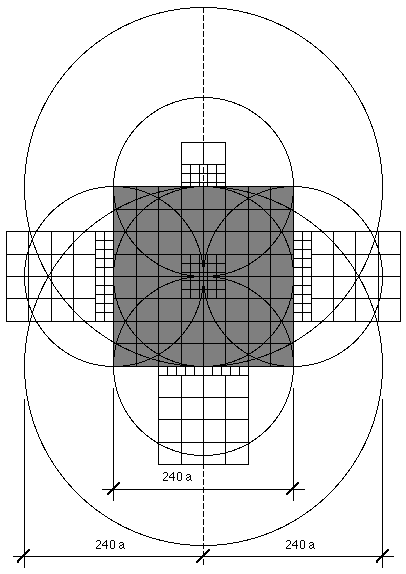
The Agnicayana is not a simple ceremony but a large-scale, multi-day ritual involving the construction of a geometrically precise altar made of hundreds, sometimes thousands, of specially prepared bricks. Each brick, each placement, each accompanying chant and gesture is prescribed in detail. The ritual unfolds as a sequence of actions distributed across time, participants, and spatial arrangements.
What immediately stands out in Staal’s analysis is the formal precision of the ritual. The altar itself is not arbitrary; it follows strict geometrical patterns, often with symbolic correspondences suggested in later interpretations. However, Staal is careful to separate these interpretations from the actual performance. The builders of the altar follow rules—measurements, sequences, placements—not symbolic meanings. The structure is executed correctly whether or not its supposed symbolism is understood.

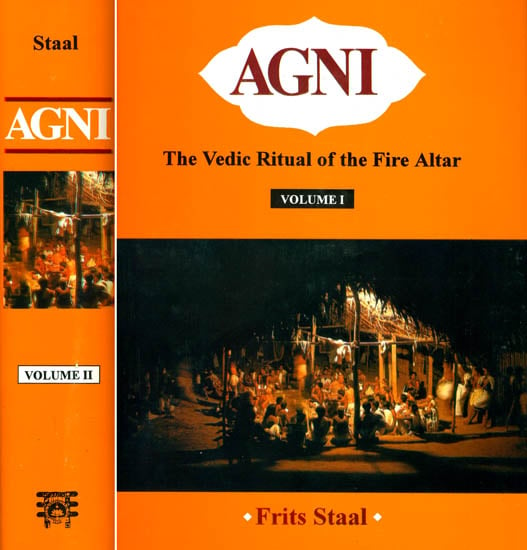

The empirical material for this chapter is drawn largely from the 1975 performance of the Agnicayana ritual by Nambudiri Brahmins in Kerala, which Staal studied in detail. This event provided a rare opportunity to observe a living performance of a ritual that had been transmitted for centuries with remarkable fidelity. The data collected from this performance form the backbone of his analysis.
One of the most striking features of the Agnicayana is its modularity. The ritual is composed of smaller units—rites—that can be combined, extended, or transformed. These units function much like syntactic elements in language. They are not meaningful in themselves; their significance lies in how they are arranged within the larger structure.
For example, certain sequences of offerings or chants recur in different contexts, sometimes with variations. These variations are not random but governed by rules. A sequence can be expanded, embedded within another, or transformed according to specific procedures. This gives the ritual a generative character: from a finite set of elements and rules, a potentially vast range of ritual forms can be produced.
Staal emphasizes that this generativity is independent of meaning. The rules that govern the combination of ritual elements do not depend on what those elements signify. They operate at a purely formal level. This is analogous to syntax in language, where rules determine how words can be combined regardless of their meaning.
Another key aspect is the temporal structure of the ritual. The Agnicayana unfolds over several days, with precise timing for each action. Certain rites must occur at specific moments, often in relation to others. This creates a layered structure in which sequences are nested within larger sequences. The ritual is not merely a linear progression but a complex hierarchy of actions.
Spatial structure is equally important. The layout of the altar, the positions of participants, and the arrangement of materials all follow strict rules. These spatial relations are integral to the ritual’s structure, not symbolic representations to be interpreted. They are part of the system’s syntax.
A crucial observation emerges from the behavior of the participants. The priests involved in the ritual are highly trained and capable of executing complex sequences with precision. Yet, when asked about the meaning of what they are doing, their responses are often vague, inconsistent, or absent. Some may offer traditional explanations, but these do not guide the performance itself. The performance is guided by rules that have been learned and internalized through practice.
This reinforces one of Staal’s central claims: the meaning of a ritual, if it exists, is not necessary for its execution. The system functions independently of interpretation. Meaning, in this context, is an optional overlay rather than a constitutive element.
Staal also addresses the common assumption that such elaborate rituals must encode deep symbolic or cosmological meanings. While it is true that later traditions have attached interpretations to various elements of the Agnicayana—linking the altar to cosmic structures, for example—these interpretations are not required for the ritual to function. They are secondary, often retrospective, and may vary without affecting the structure of the ritual.
This leads to a decisive conclusion: the complexity of the Agnicayana is not evidence of hidden meaning but of formal organization. The ritual’s intricacy arises from the rules that govern it, not from the depth of its symbolism.
The chapter also highlights the stability of the system. Despite changes in language, culture, and historical context, the core structure of the Agnicayana has been preserved. This stability is not due to the preservation of meaning—meanings have changed or been lost—but to the preservation of rules. The transmission of the ritual depends on the accurate reproduction of its structure.
By the end of the chapter, the empirical case is firmly established. The Agnicayana exemplifies a system that is:
Highly structured and rule-governed Generative and modular Independent of semantic understanding Stable across time due to its formal properties
This is no longer a theoretical claim but an observed reality. The ritual operates as a system of rules without meaning.
What follows in the next chapter will move from this large-scale example to the analysis of more basic ritual units, further clarifying how these structures are built and how they function. The argument will continue to deepen, but its foundation is now unmistakable: ritual is not a language of symbols—it is a formal system of actions.
Chapter 9: Basic Rites
After establishing the overwhelming complexity of the Agnicayana, Staal now deliberately shifts scale. The purpose of this chapter is analytical: to break down large ritual systems into their constituent elements and examine the simplest units from which complex structures are built. If the previous chapter demonstrated ritual as a grand architecture, this one examines its bricks.
The focus falls primarily on two fundamental categories of Vedic rites: the Iṣṭi and the Soma sequences. These are not marginal components but core building blocks of the ritual system. By analyzing them in isolation, Staal is able to show that even at the most basic level, ritual exhibits the same defining features—rule-governed structure, procedural precision, and independence from meaning.
The Iṣṭi is a relatively simple offering ritual. It consists of a sequence of actions involving preparation, invocation, offering, and completion. Each step is prescribed in detail: what materials are used, what words are recited, what gestures are performed, and in what order. The sequence is fixed, and deviations are not permitted. The correctness of the ritual lies entirely in its conformity to this sequence.
What is significant is that the structure of the Iṣṭi can be described without reference to meaning. One can specify the order of actions, the roles of participants, and the transformations involved without invoking any symbolic interpretation. The ritual is, in effect, a formal procedure—a sequence of operations governed by rules.
The Soma rituals introduce greater complexity. They involve extended sequences of actions centered around the extraction, preparation, and offering of the Soma plant. These sequences are not merely longer but structurally richer. They include repeated patterns, variations, and embedded sub-rituals. Yet, despite this complexity, the same principle holds: the system is governed by rules that determine how elements are combined and transformed.
Staal’s analysis reveals that these basic rites function much like syntactic units in language. They can be combined, extended, and modified according to specific rules. Larger rituals, such as the Agnicayana, are constructed by embedding and transforming these basic units. The relationship between simple and complex rituals is thus analogous to the relationship between words, phrases, and sentences.
A key insight emerges here: ritual structure is hierarchical. Basic units are nested within larger structures, which in turn can be part of even larger sequences. This hierarchical organization is governed by rules that specify how units can be combined. The system is not arbitrary; it is constrained by formal principles.
Importantly, these principles operate independently of meaning. The same basic rite can appear in different contexts, combined with different elements, without any change in its supposed meaning. What changes is its position within the structure, not its semantic content. This reinforces the idea that ritual is not a system of symbols but a system of operations.
Staal also emphasizes the role of repetition. Basic rites often involve repeated sequences, sometimes with slight variations. These repetitions are not redundant; they are integral to the structure. They create patterns that can be analyzed formally, much like recurring motifs in music or repeated constructions in language. The significance of repetition lies in its structural function, not in any symbolic meaning.
Another important aspect is the precision with which these rites are performed. Even the simplest ritual requires exact adherence to prescribed rules. This precision is not motivated by meaning; it is intrinsic to the system. A ritual is correct or incorrect based on its conformity to rules, not on its interpretation.
Staal’s empirical observations again support this point. Practitioners are trained to perform these rites accurately, often through memorization and practice rather than through understanding. They know what to do and how to do it, but not necessarily why. This distinction between procedural knowledge and semantic understanding is central to his argument.
The chapter also subtly addresses a potential objection: that meaning might be present at a deeper level, even if it is not explicitly articulated. Staal’s response is methodological. If meaning is not required for the performance, transmission, or analysis of the ritual, then it cannot be considered essential. It may exist as an optional layer, but it does not define the system.
By isolating basic rites, Staal strengthens his overall thesis. The absence of meaning is not a byproduct of complexity or historical decay; it is present at the most fundamental level. Even the simplest rituals operate as rule-governed systems independent of semantic content.
This has an important cumulative effect. The argument is no longer based on exceptional cases or large-scale phenomena. It applies uniformly across the system—from the smallest units to the most complex constructions. Ritual, at every level, is structured by rules rather than meaning.
The chapter thus prepares the way for a deeper structural analysis in the following chapters. Having identified the basic units and their properties, Staal will next examine how these units are combined and transformed, revealing the full extent of ritual syntax.
Chapter 10: The Structure of Ritual
With the basic units of ritual now isolated, Staal advances to a more systematic level of analysis. This chapter is where the analogy with linguistics becomes most explicit—not in the sense that ritual is a language, but in the sense that it possesses a structure that can be formally described. The aim here is to articulate the internal organization of ritual as a system of relations governed by rules.
The key shift is from elements to structure. Instead of examining individual rites (such as Iṣṭi or Soma sequences), Staal now asks how these elements are arranged into larger configurations. What principles govern their combination? What kinds of patterns emerge when rituals are viewed as wholes?
The answer lies in the identification of syntactic organization within ritual. Just as sentences are not random collections of words but structured according to grammatical rules, rituals are not arbitrary sequences of actions. They are organized according to principles that determine how components can be combined, ordered, and related.
One of the most important features of this organization is sequencing. Ritual actions must occur in a specific order, and this order is not interchangeable. The sequence itself is part of the structure. Changing the order of actions can invalidate the ritual, just as altering the order of words can render a sentence ungrammatical.
However, sequencing alone does not capture the full complexity. Staal identifies hierarchical structure as another defining characteristic. Rituals are composed of nested units: smaller rites are embedded within larger ones, which in turn may be part of even more extensive sequences. This creates a layered organization, where relationships between elements are not merely linear but hierarchical.
This hierarchy is governed by rules that specify how embedding can occur. Certain rites can contain others; some cannot. Some sequences can be expanded by inserting additional elements; others are fixed. These constraints function much like grammatical rules, defining the permissible structures within the system.
Another crucial feature is transformation. Ritual elements can be modified according to specific rules. A basic rite may appear in different forms depending on its context within a larger structure. These transformations are not arbitrary variations but systematic operations governed by the logic of the ritual system.
Staal shows that these transformations can be described formally, much like transformations in linguistic theory. A given structure can be derived from another through a series of rule-governed operations. This reinforces the idea that ritual is a generative system: from a finite set of elements and rules, a wide range of structures can be produced.
Importantly, all of this can be described without reference to meaning. The structure of ritual is independent of any symbolic interpretation. One can analyze sequences, hierarchies, and transformations purely in terms of their formal properties. This is the decisive methodological point: ritual can be studied as a system of rules in its own right.
Staal also addresses the temptation to interpret structure symbolically. It is often assumed that hierarchical arrangements or repeated patterns must correspond to cosmological or theological ideas. However, he argues that such interpretations are secondary. The structure exists prior to and independently of any meaning attributed to it. To conflate the two is to misunderstand the nature of the system.
A further dimension of structure is parallelism. Rituals often involve parallel sequences of actions performed by different participants or repeated in different contexts. These parallel structures can be analyzed in terms of symmetry and correspondence, again without invoking meaning. They are formal relationships within the system.
The chapter also touches on the role of constraints. Not all combinations of ritual elements are allowed. The system includes restrictions that limit what can occur. These constraints are part of the rule system and contribute to the overall coherence of the ritual. They function similarly to grammatical constraints in language, which determine what counts as a well-formed sentence.
Through this analysis, Staal demonstrates that ritual possesses a level of organization comparable to that of formal systems studied in linguistics and mathematics. It is not a loose collection of symbolic acts but a tightly structured system governed by explicit and implicit rules.
This leads to a broader implication. If ritual has a syntax, then its study should resemble the study of syntax in language. The task is not to interpret meanings but to describe structures, identify rules, and analyze transformations. This represents a fundamental shift in the methodology of ritual studies.
At the same time, Staal maintains a crucial distinction: ritual is not language. While both are rule-governed systems, they operate in different domains. Language involves expressions that can carry meaning; ritual involves actions that need not. The analogy is therefore limited but instructive.
By the end of the chapter, the concept of “ritual syntax” is firmly established. The system is shown to be:
Sequential and ordered Hierarchical and embedded Transformational and generative Constrained by formal rules Independent of semantic interpretation
This structural framework sets the stage for the next chapter, where Staal will explore more advanced operations—particularly embedding and transformation—in greater detail. The argument continues to build, moving from the identification of structure to the analysis of how that structure operates dynamically within the ritual system.
Chapter 11: Embedding and Transformation
Having established that ritual possesses a syntax-like structure, Staal now moves to its most sophisticated operations: embedding and transformation. This chapter represents the technical core of his analysis of ritual as a formal system. If Chapter 10 identified structure, Chapter 11 demonstrates how that structure is dynamically generated and expanded.
The concept of embedding refers to the insertion of one ritual sequence within another. A basic rite does not always stand alone; it can be incorporated into a larger sequence, functioning as a component within a higher-level structure. This is analogous to the way clauses can be embedded within sentences in language. The resulting structure is not merely longer but hierarchically more complex.
Staal shows that embedding in ritual is not arbitrary. It is governed by specific rules that determine which elements can be inserted, where they can be placed, and how they interact with the surrounding structure. These rules create a layered system in which smaller units are nested within larger ones, often at multiple levels.
One of the most illuminating examples comes from the transformation of simpler Soma rituals into the more elaborate Agnicayana. What appears, on the surface, as a completely different ritual can be analyzed as a systematic expansion of a simpler structure. Elements are added, sequences are extended, and new layers are introduced—but all according to rules that preserve the coherence of the system.
This leads directly to the notion of transformation. Ritual structures can be modified through operations that alter their form while maintaining their internal logic. A sequence may be expanded by repetition, modified by substitution, or reconfigured through reordering—provided these changes conform to the rules of the system.
Staal emphasizes that these transformations are not guided by meaning. They are formal operations. A transformation does not occur because it expresses a different idea or symbolizes a new concept; it occurs because the rules of the system permit it. This is a crucial point. It reinforces the autonomy of ritual syntax from semantics.
The analysis becomes particularly precise when Staal examines specific cases, such as the transformation from Agniṣṭoma (a basic Soma ritual) to Agnicayana (a highly elaborate one). The latter can be derived from the former through a series of rule-governed expansions and insertions. What seems like qualitative difference is revealed to be quantitative and structural.
This generative capacity is one of the most striking features of ritual. From a finite set of elements and rules, an extensive range of ritual forms can be produced. The system is not static but productive. It allows for variation and complexity without requiring new meanings or interpretations.
Another important aspect is the role of recursion. Certain structures can be repeated within themselves, creating potentially unbounded complexity. While ritual systems do not exhibit recursion in the same unlimited way as language, they do show forms of repeated embedding that approximate it. This further strengthens the analogy with formal systems.
Staal also notes that these operations can be described with a high degree of precision. It is possible to formulate rules that account for how rituals are constructed, much like grammatical rules account for sentence formation. This opens the possibility of a formal science of ritual—one that analyzes structure rather than meaning.
A significant implication follows. If ritual structures can be generated and transformed through rules, then their complexity does not require explanation in terms of symbolic content. The intricacy of a ritual is not evidence of deep meaning but of elaborate rule systems. Complexity arises from formal operations, not from semantic depth.
The chapter also addresses the relationship between variation and stability. While rituals can be transformed and expanded, these changes occur within a constrained system. The rules ensure that variations remain coherent and recognizable. This balance between flexibility and constraint is a hallmark of rule-governed systems.
Staal’s analysis thus reveals ritual as a dynamic system—capable of growth, variation, and complexity, yet grounded in a stable set of rules. This dynamic aspect distinguishes ritual from static symbolic interpretations, which tend to treat it as a fixed set of meanings.
By the end of the chapter, the argument reaches a new level of clarity. Ritual is shown to be:
Generative, producing complex structures from simple elements Hierarchical, with multiple levels of embedding Transformational, allowing systematic modification Rule-governed, independent of semantic interpretation
These properties place ritual firmly within the domain of formal systems. The analogy with language is now fully developed, not at the level of meaning but at the level of structure and generation.
This prepares the way for the next chapter, where Staal will make the comparison explicit by examining the relationship between ritual and grammar. The question will no longer be whether ritual has structure—it will be how closely that structure parallels the formal systems studied in linguistics, and what this implies for the nature of ritual itself.
Chapter 12: Ritual and Grammar
At this stage, Staal makes his most explicit and carefully qualified comparison: ritual and grammar. This chapter is pivotal because it consolidates the structural insights developed so far and situates ritual within a broader class of formal systems. At the same time, it draws a strict boundary—ritual is not language, even if it shares certain properties with it.
The central claim is that ritual possesses something analogous to grammar. Just as grammar consists of rules that generate well-formed sentences, ritual consists of rules that generate well-formed sequences of actions. These rules determine what counts as a correct ritual performance, independent of any meaning that may be attached to it.
This comparison is not metaphorical but analytical. Staal demonstrates that many of the concepts used in linguistic theory—such as syntax, hierarchy, transformation, and recursion—can be applied to ritual in a precise way. Ritual sequences can be parsed, their components identified, and their combinations described in terms of formal rules.
However, Staal is equally insistent on the limits of the analogy. Grammar in language is ultimately connected to meaning, even if syntax operates independently. Ritual, by contrast, does not require meaning at any level. While linguistic expressions can be meaningful or meaningless, ritual actions do not function as carriers of meaning in the same way. They are not expressions but performances.
This distinction leads to a refinement of his earlier thesis. Ritual is not a language without meaning; it is a different kind of system altogether. It resembles language in its formal properties but differs fundamentally in its function. Language is used to communicate, to refer, to express. Ritual does none of these in any essential sense.
One of the most important insights of the chapter is that ritual correctness is grammatical rather than semantic. A ritual is correct if it follows the rules of the system, just as a sentence is grammatical if it conforms to syntactic rules. The criterion of correctness is internal to the system. It does not depend on external interpretation or validation.
Staal also explores the idea of ritual competence in parallel with linguistic competence. Just as speakers possess an implicit knowledge of grammatical rules, ritual practitioners possess an implicit knowledge of ritual rules. This knowledge is acquired through training and practice, not through understanding meaning. It is procedural and embodied rather than conceptual.
Another significant point concerns the autonomy of the system. Grammar can be studied independently of semantics, and ritual can be studied independently of belief or symbolism. This autonomy allows for a scientific approach: one can describe the rules, analyze the structures, and formulate generalizations without appealing to meaning.
At the same time, Staal acknowledges that interpretations of ritual exist and have historically been important. Rituals have been explained in terms of cosmology, theology, and symbolism. However, he argues that these interpretations are secondary. They are not part of the system itself but are imposed upon it. They may vary across time and context without affecting the structure of the ritual.
This leads to a critical methodological conclusion: interpretation is not explanation. To assign meaning to a ritual is not to explain how it works. Explanation requires identifying the rules and structures that generate the ritual. Meaning, even if present, does not account for the organization or persistence of the system.
Staal further strengthens his argument by pointing out that grammar itself was historically developed in connection with ritual. In ancient India, grammatical analysis emerged in part from the need to preserve and correctly perform Vedic recitations. This historical link underscores the deep connection between rule-governed systems of language and ritual, while also highlighting their differences.
The chapter also addresses potential objections. One might argue that ritual must have meaning because it is embedded in religious contexts. Staal’s response is that context does not determine structure. Ritual may coexist with belief, but it is not reducible to it. The same ritual structure can persist across different interpretive frameworks, suggesting that its essence lies elsewhere.
By the end of the chapter, the comparison with grammar has clarified the nature of ritual:
Ritual is governed by rules analogous to grammatical rules Its correctness is determined by conformity to these rules It can be analyzed formally, without reference to meaning It is autonomous from interpretation, belief, and symbolism
At the same time, the limits of the analogy have been carefully maintained. Ritual is not a language; it is a system of action. Its study requires methods similar to those used in linguistics but adapted to a different domain.
This chapter thus consolidates the structural theory of ritual and prepares the ground for a critical confrontation with existing interpretations. In the next chapter, Staal will examine how ritual has been understood—both in Indian traditions and in Western scholarship—and will argue that these interpretations, while influential, fail to capture the true nature of ritual as a system of rules without meaning.
Chapter 13: Interpretations of Ritual
Having established a structural account of ritual, Staal now turns to confront the dominant traditions that have attempted to explain it. This chapter is critical in tone and diagnostic in purpose. It does not merely survey interpretations; it shows why they systematically fail. The core claim—developed here with full force—is that most interpretations of ritual are misguided because they presuppose meaning where none is required.
Staal divides these interpretations into two broad categories: Indian and Western. This division is not geographical alone but methodological. Both traditions, despite their differences, share a common assumption—that ritual must be meaningful, and that understanding it consists in uncovering that meaning.
He begins with Indian interpretations. Within the Vedic and post-Vedic traditions, ritual has been explained in a variety of ways: as a means of maintaining cosmic order, as a reenactment of myth, as a path to spiritual realization, or as a system of symbolic correspondences between microcosm and macrocosm. These interpretations are often sophisticated and internally coherent. They form part of a long intellectual tradition that seeks to integrate ritual into broader philosophical and theological frameworks.
However, Staal points out that these interpretations are secondary. They arise after the fact, as attempts to make sense of practices that are already established. The rituals themselves do not depend on these explanations. They can be performed without reference to them, and historically they often have been. Moreover, different interpretations coexist, sometimes contradicting one another, without affecting the structure of the ritual.
This multiplicity is significant. If a ritual had an intrinsic meaning, one would expect a stable and consistent interpretation. Instead, we find a proliferation of meanings, suggesting that interpretation is not grounded in the structure of the ritual but imposed upon it. Meaning, in this context, is not discovered but constructed.
Staal then turns to Western interpretations, particularly those developed in anthropology and religious studies. Here, the dominant approach has been symbolic or functional. Rituals are seen as expressions of social values, as mechanisms for reinforcing group cohesion, or as symbolic representations of cosmological beliefs.
Thinkers such as Victor Turner and Clifford Geertz exemplify this interpretive tradition. They analyze ritual as a system of symbols that communicates meaning within a cultural context. The task of the scholar is to decode these symbols and reveal the underlying significance.
Staal’s critique is direct. These approaches assume what they are trying to prove—that ritual is meaningful. They begin with the premise that rituals must express something, and then proceed to interpret them accordingly. But this premise is precisely what is in question. By focusing on meaning, these interpretations overlook the formal structure of ritual and the rules that govern it.
He also notes that different scholars often produce different interpretations of the same ritual, each claiming validity. This situation mirrors what was observed in Indian traditions: a plurality of meanings attached to a single structure. Again, this suggests that meaning is not inherent but contingent.
A particularly sharp point in the chapter is the distinction between interpretability and meaningfulness. A phenomenon can be interpreted in many ways without possessing intrinsic meaning. Rituals are highly interpretable—they invite explanation, symbolism, and narrative—but this does not mean that they are inherently meaningful. The capacity to generate interpretations is not evidence of meaning.
Staal further argues that the search for meaning can obscure the actual features of ritual. By focusing on symbolism, scholars may neglect the precise sequences, rules, and structures that define the ritual. Interpretation becomes a distraction, leading away from the phenomenon rather than toward it.
The culmination of the chapter is the explicit articulation of his thesis: ritual is meaningless. This statement is deliberately provocative, but it must be understood carefully. Staal does not mean that ritual is trivial or without significance. Rather, he means that ritual does not possess meaning in the semantic sense—that it does not function as a system of symbols conveying information or beliefs.
Instead, ritual is a system of rules. Its significance lies in its structure and performance, not in what it represents. Meaning, when it appears, is an external addition, not an intrinsic property.
This conclusion has profound implications. It challenges the foundations of entire fields of study that have been built on the assumption that ritual is meaningful. It calls for a reorientation of methodology—from interpretation to analysis, from symbolism to structure.
At the same time, it opens a new perspective. By freeing ritual from the burden of meaning, it becomes possible to study it as a phenomenon in its own right. Its complexity, precision, and persistence can be understood in terms of rules, transmission, and performance, rather than belief or symbolism.
The chapter thus marks a turning point. The theoretical framework is no longer merely proposed; it is defended against competing explanations. The ground is cleared for a new approach—one that will be extended in the following chapters to anthropology, music, language, and ultimately to the human sciences as a whole.
Chapter 14: Anthropology without Asia
In this chapter, Staal broadens his critique from specific interpretations of ritual to the discipline of anthropology itself. The title is deliberately pointed. It suggests that much of anthropological theory—especially as developed in the West—has operated with a striking blind spot: it has largely ignored, or inadequately engaged with, the vast and highly developed ritual traditions of Asia.
This omission is not merely geographical; it is conceptual. By focusing primarily on small-scale societies and interpreting ritual through frameworks of symbolism, social function, or psychological meaning, anthropology has constructed theories that are ill-equipped to account for systems like Vedic ritual. These theories assume that ritual is meaningful, communicative, or expressive. But as Staal has shown, Vedic ritual does not conform to these assumptions.
The chapter proceeds through a critical examination of influential anthropologists, including Raymond Firth and Victor Turner. Both scholars contributed significantly to the understanding of ritual within their respective frameworks. Firth emphasized the social and functional aspects of ritual, while Turner developed a symbolic and processual approach, focusing on meaning, transformation, and communal experience.
Staal’s critique is not dismissive but diagnostic. He acknowledges the richness of their analyses but argues that they are limited by their underlying assumptions. In both cases, ritual is treated as a system of symbols that must be interpreted. The emphasis is on what rituals mean—for individuals, for society, or for the participants themselves.
The problem, as Staal sees it, is that these approaches cannot account for rituals that operate independently of meaning. When confronted with such cases, anthropologists tend either to impose interpretations or to overlook the formal structure of the ritual altogether. The result is a distorted picture, in which the most significant features of the phenomenon are ignored.
A key point in the chapter is the contrast between data and theory. Anthropological theories of ritual have often been developed without reference to the most complex and well-documented ritual systems, such as those of India. This leads to a mismatch between theory and evidence. Theories that work for certain types of rituals—especially those that are overtly symbolic or communicative—fail when applied to highly formalized systems like the Agnicayana.
Staal suggests that this is not an accidental oversight but a structural limitation of the discipline. Anthropology has historically been oriented toward interpretation, meaning, and social function. These priorities shape what is observed, how it is described, and what is considered relevant. As a result, phenomena that do not fit these categories are marginalized or misunderstood.
Another important aspect of the chapter is the critique of symbolism. Anthropologists often treat ritual elements as symbols that represent something else—cosmic principles, social relations, psychological states. Staal argues that this approach confuses two distinct levels: the structure of the ritual and the interpretations attached to it. Symbolic explanations may be offered, but they do not account for the rules that govern the ritual’s execution.
He also points out that symbolic interpretations are often inconsistent. Different scholars, or even participants within the same tradition, may assign different meanings to the same ritual elements. This variability suggests that symbolism is not intrinsic to the ritual but imposed upon it.
The chapter further explores the implications of ignoring Asian traditions. By excluding or underestimating these traditions, anthropology has limited its scope and constrained its theoretical development. Vedic ritual, with its complexity and formal rigor, provides a counterexample that challenges existing models. Incorporating such data would require a rethinking of fundamental assumptions.
Staal’s broader aim is to reposition ritual within the human sciences. Instead of treating it as a subset of symbolic behavior or social practice, he proposes that it be studied as a formal system in its own right. This requires a shift in methodology—from interpretation to structural analysis, from meaning to rules.
The phrase “anthropology without Asia” thus becomes a critique of a discipline that has overlooked crucial evidence. It is also a call for a more comprehensive and inclusive approach—one that takes seriously the diversity of human practices and the possibility that some of them may not conform to prevailing theories.
By the end of the chapter, the implications of Staal’s argument extend beyond ritual. They challenge the foundations of anthropological theory and, more broadly, the human sciences. If ritual can exist without meaning, then the centrality of meaning in the study of human behavior must be reconsidered.
This prepares the ground for the next stage of the book, where Staal will explore the relationship between ritual and other domains—such as language, music, and performative action—further expanding the scope of his analysis and reinforcing the idea that rule-governed systems without meaning are a fundamental aspect of human activity.
Chapter 15: Syntax, Semantics and Performatives
At this point, Staal turns to a crucial conceptual clarification. Having argued that ritual is a rule-governed system independent of meaning, he now addresses a potential counterargument arising from philosophy of language—especially the theory of performatives. This chapter examines whether ritual might still be considered meaningful in a non-descriptive sense, even if it does not convey propositions.
The discussion is framed around the distinction between syntax and semantics. Syntax concerns the structure of expressions—the rules that govern how elements are combined. Semantics concerns meaning—the relationship between expressions and what they signify. Staal has consistently argued that ritual belongs to the domain of syntax rather than semantics. Now he tests this claim against a more subtle theory that attempts to expand the notion of meaning.
The key figure in this discussion is J. L. Austin, whose theory of performative utterances challenged the traditional view that language is primarily descriptive. According to Austin, some utterances do not describe states of affairs but perform actions. For example, saying “I promise” is not describing a promise; it is making one. Such utterances are meaningful not because they refer to something but because they do something.
This idea has been influential in the study of ritual. If language can perform actions, then perhaps ritual actions can be understood as performatives—acts that have meaning because they bring about certain effects. Rituals might then be seen as meaningful performances rather than symbolic representations.
Staal examines this possibility carefully but ultimately rejects it. His argument hinges on the distinction between linguistic performatives and ritual actions. In Austin’s framework, performatives are still part of language. They are governed by conventions that link specific utterances to specific actions within a social context. Their meaning lies in their function within a system of communication.
Ritual, however, does not operate in this way. Ritual actions are not utterances; they are sequences of behavior governed by rules. While they may have effects—social, psychological, or otherwise—these effects do not constitute meaning in the linguistic sense. The rules that govern ritual are not conventions that assign meaning but procedures that determine correctness.
Staal also points out that performatives depend on contextual conditions. For a performative utterance to be valid, certain conditions must be met—appropriate authority, proper circumstances, and so on. These conditions are part of the meaning of the utterance. In ritual, by contrast, the focus is not on contextual validity but on formal correctness. The ritual is valid if it is performed according to the rules, regardless of interpretation.
Another important distinction is between pragmatics and structure. Pragmatics deals with how language is used in context—how meaning is shaped by intention, situation, and interaction. Some scholars have attempted to analyze ritual in pragmatic terms, treating it as a form of communication or social action. Staal argues that this approach, like semantic interpretation, misses the point. It shifts attention to context and use, rather than to the internal structure of the ritual.
The chapter also revisits the concept of performance. Ritual is undeniably a performance—it involves actions carried out in time, often with participants and observers. However, performance does not imply meaning. A performance can be governed by rules without conveying a message. The theatrical or aesthetic aspects of ritual do not transform it into a system of communication.
Staal’s analysis leads to a refinement of his thesis. Ritual is not meaningful in the semantic sense, nor is it meaningful in the performative or pragmatic sense. It is not a form of language, whether descriptive or performative. It is a distinct kind of system—one that operates through rules rather than meaning.
This conclusion has significant implications. It closes off a major avenue through which meaning might have been reintroduced into the analysis of ritual. Even the expanded notion of meaning offered by performative theory does not apply. Ritual remains, in Staal’s formulation, a system of rules without meaning.
At the same time, the chapter clarifies the relationship between ritual and language. While they share certain features—such as rule-governed structure and performance—they belong to different domains. Language is fundamentally tied to meaning, even in its performative uses. Ritual is not.
By the end of the chapter, the argument has achieved a new level of precision. It is no longer sufficient to say that ritual lacks meaning in a general sense. One must specify that it lacks meaning in all the relevant senses—semantic, pragmatic, and performative.
This prepares the way for the next chapter, where Staal will explore an unexpected comparison: the relationship between ritual and music. Unlike language, music is another domain where structure and performance play a central role, often without clear semantic content. The comparison will further illuminate the nature of ritual as a formal system.
Chapter 16: Music and Ritual
In this chapter, Staal introduces a comparison that is both illuminating and strategically important: ritual and music. Unlike language, which is deeply entangled with meaning, music provides a domain where complex, rule-governed structures exist with little or no semantic content. By placing ritual alongside music, Staal strengthens his central thesis—showing that “rules without meaning” are not anomalous but characteristic of certain fundamental human activities.
The comparison begins with structure. Music, like ritual, is highly organized. It consists of sequences, patterns, repetitions, variations, and hierarchical arrangements. Musical compositions are governed by rules—whether formalized (as in classical traditions) or implicit (as in folk or oral traditions). These rules determine what counts as a correct or coherent performance.
Crucially, this structure operates independently of meaning. While music can evoke emotions, associations, or interpretations, it does not mean anything in the semantic sense. There is no fixed correspondence between a musical phrase and a specific idea or object. The same piece of music can be interpreted in multiple ways, or not interpreted at all, without affecting its structure.
Staal identifies a strong parallel with ritual. Rituals, like musical compositions, are sequences of actions organized according to rules. They involve repetition, variation, and hierarchical structure. They can be performed correctly or incorrectly based on adherence to these rules. And, like music, they do not require meaning to function.
He develops this comparison by analyzing structural correspondences. Just as music has scales, rhythms, and compositional forms, ritual has sequences, modules, and transformations. In both cases, complexity arises from the combination and variation of basic elements. The system is generative: from a finite set of rules, a wide range of structures can be produced.
Staal also points to the role of performance. Both music and ritual are temporal arts—they unfold over time and require skilled execution. The performer’s task is not to interpret meaning but to realize the structure accurately. A musician need not know what a piece “means” to perform it correctly; similarly, a ritual practitioner need not understand the meaning of a ritual to execute it properly.
Another important parallel is the role of tradition and transmission. Both music and ritual are often preserved through oral traditions, where accuracy is maintained through repetition and training. The emphasis is on fidelity to form rather than on semantic understanding. This ensures the stability of the system across generations.
Staal further explores the idea of pure structure. In music, especially in certain traditions, structure can become an end in itself. Compositions may be appreciated for their formal properties—symmetry, complexity, variation—rather than for any external meaning. Ritual, he suggests, operates in a similar way. Its significance lies in its structure and performance, not in what it represents.
The comparison also helps clarify a common misunderstanding. Because ritual, like music, can evoke responses—emotional, aesthetic, or social—it is often assumed to be meaningful. But these responses do not constitute meaning in the semantic sense. They are effects, not content. To conflate the two is to misunderstand the nature of the system.
Staal’s argument here is cumulative. Having shown that language contains rule-governed structures independent of meaning, and that ritual operates as a formal system, he now demonstrates that music provides an independent example of the same phenomenon. This triangulation strengthens his thesis. It shows that “rules without meaning” are not peculiar to ritual but are part of a broader class of human activities.
The chapter also subtly shifts the perspective on ritual. By comparing it to music, Staal moves away from viewing ritual as a cognitive or symbolic system and toward viewing it as a performative art. This does not mean that ritual is aesthetic in the same way as music, but it highlights its structural and procedural character.
By the end of the chapter, the analogy has clarified several key points:
Ritual, like music, is a structured system governed by rules Its performance depends on procedural competence, not semantic understanding Its effects do not imply meaning Its complexity arises from formal organization rather than symbolic content
This comparison reinforces the central thesis while broadening its scope. Ritual is no longer an isolated case; it belongs to a wider category of rule-governed human activities that operate independently of meaning.
The next chapter will return to mantras, examining them more closely in their ritual context. There, Staal will show that even linguistic elements—when embedded in ritual—can function without meaning, further blurring the boundary between language and non-language and deepening the argument that rules, not meaning, are fundamental.
Chapter 17: Six Vedic Mantras
With the structural analysis of ritual firmly established, Staal now turns to mantras themselves. This chapter marks a subtle but important shift: from action (ritual) to sound (mantra). If ritual actions were shown to be rule-governed without meaning, the question now becomes more delicate—can linguistic material itself function without meaning?
To address this, Staal begins with six specific Vedic mantras. These are not chosen for their philosophical depth or theological richness, but precisely because they reveal something else: the autonomy of sound and structure from semantic content.
At first glance, mantras appear to belong clearly to language. They consist of words, often in archaic Sanskrit, and are embedded in ritual contexts. Traditional interpretations frequently treat them as meaningful utterances—invocations, praises, or symbolic expressions addressed to deities. However, Staal approaches them differently. He brackets interpretation and examines how they function within ritual performance.
What emerges is striking. Many of these mantras, when analyzed closely, either lack clear meaning or possess meanings that are irrelevant to their ritual use. Some are fragmentary, some obscure, and some consist of sequences whose semantic coherence is doubtful or lost. Yet they are preserved and recited with extraordinary precision.
This leads to a crucial observation: the correctness of a mantra lies in its form, not its meaning. The phonetic details—accent, pitch, duration, sequence—are meticulously maintained. Errors in pronunciation are considered serious, even if the semantic content is not understood. This indicates that what matters is not what the mantra says, but how it is said.
Staal emphasizes that this is not a marginal phenomenon. It is central to the Vedic tradition. Mantras are transmitted orally with exacting standards, often through elaborate mnemonic techniques. Practitioners may memorize vast corpora of mantras without knowing their meanings. The system functions because of its rules of recitation, not because of semantic comprehension.
The chapter also introduces the idea of sound as structure. In mantras, sound patterns—rhythm, repetition, phonetic arrangement—play a primary role. These patterns can be analyzed formally, much like musical structures. The focus shifts from semantics to phonology, from meaning to sound organization.
Another important point is the relationship between mantra and ritual context. A mantra does not function independently; it is embedded within a sequence of ritual actions. Its role is defined by its position in that sequence, not by its meaning. The same mantra can appear in different contexts, performing different functions, without any change in its semantic content.
This reinforces the idea that meaning is not constitutive. Even when a mantra has a recognizable meaning, that meaning does not determine its use. The rules of the ritual system do.
Staal also addresses the historical dimension. Over time, the meanings of many mantras have become obscure or contested. Yet the mantras themselves continue to be recited unchanged. This persistence suggests that meaning is not necessary for transmission. The system is sustained by formal rules, not by semantic continuity.
A particularly revealing aspect of the chapter is the distinction between interpretation and function. Scholars and practitioners may offer interpretations of mantras, linking them to deities, cosmology, or metaphysical concepts. But these interpretations do not explain how mantras operate within the ritual system. They are external overlays, not internal mechanisms.
By analyzing specific examples, Staal demonstrates that mantras behave like elements of a formal system. They are units that can be combined, repeated, and transformed according to rules. Their significance lies in their role within this system, not in their meaning.
The chapter thus extends the thesis of “rules without meaning” into the domain of language itself. Even linguistic expressions, when functioning as mantras, can operate independently of meaning. This challenges the assumption that language is inherently meaningful and suggests that its formal properties can be detached from semantics.
By the end of the chapter, several conclusions are clear:
Mantras are governed by rules of sound and sequence Their correctness depends on phonetic precision, not meaning They can function without semantic understanding Their role is determined by ritual context, not by interpretation
This deepens the overall argument significantly. It is no longer just that ritual actions lack meaning; even linguistic elements within ritual can lose their semantic function and become part of a purely formal system.
The next chapter will build on this by examining the ritual context of mantras more systematically, showing how their placement and use further reinforce their rule-governed nature and independence from meaning.
Chapter 18: Ritual Context
Having examined individual mantras, Staal now situates them within the larger system that gives them operational significance: the ritual context. This chapter is crucial because it demonstrates that whatever function mantras possess does not arise from their intrinsic meaning but from their position within a structured sequence of actions.
The central argument is straightforward but far-reaching: mantras derive their function from context, not from semantics. A mantra is not an independent linguistic unit conveying meaning; it is a component within a rule-governed system. Its role is determined by where it appears, when it is recited, and how it is integrated with other ritual elements.
Staal shows that the same mantra can be used in different rituals, or at different points within a single ritual, without any change in its supposed meaning. What changes is its function—its place in the sequence of actions. This variability would be difficult to explain if meaning were central. It becomes entirely intelligible once we recognize that the system is governed by rules of placement and combination.
The ritual context provides a kind of syntax for mantras. Just as words in a sentence acquire their role from their position within a grammatical structure, mantras acquire their role from their position within the ritual structure. The sequence, timing, and coordination with actions are what define their function.
A key implication follows: the unit of analysis is not the mantra but the ritual system. To understand how a mantra operates, one must analyze the structure in which it is embedded. Isolating the mantra and asking for its meaning misses the point. Its significance is relational, not intrinsic.
Staal reinforces this by examining how mantras are paired with specific actions—offerings, gestures, movements. These pairings are not symbolic correspondences but rule-based associations. A particular mantra must be recited at a particular moment, accompanying a particular action, according to prescribed rules. The correctness of the performance depends on this coordination.
Another important aspect is the temporal dimension. Ritual unfolds in time, and the placement of mantras within this temporal sequence is strictly regulated. A mantra recited at the wrong moment is incorrect, regardless of its meaning. This again shows that function is determined by structure, not semantics.
Staal also notes that participants often do not understand the meaning of the mantras they recite, yet they perform them correctly within the ritual. This reinforces the distinction between procedural knowledge and semantic knowledge. The practitioners know how to place and recite the mantras, even if they do not know what they mean.
The chapter further undermines the idea that mantras are communicative. If mantras were intended to convey messages—to gods, participants, or observers—one would expect their meaning to be central and stable. Instead, we find that meaning is often obscure, variable, or irrelevant, while structure and placement are precise and consistent.
Staal’s analysis leads to a broader conclusion: ritual context overrides linguistic meaning. When linguistic elements are incorporated into ritual, they are subordinated to the rules of the ritual system. Their semantic properties become secondary or even irrelevant. They function as components of a formal structure rather than as carriers of meaning.
This has significant implications for the relationship between language and ritual. It shows that linguistic material can be absorbed into non-linguistic systems and made to operate according to different principles. In ritual, language is transformed—it becomes part of a system governed by rules of action rather than rules of meaning.
The chapter also addresses a potential objection: that context itself might be a source of meaning. One might argue that the ritual context gives mantras their meaning, even if they lack intrinsic semantics. Staal counters this by distinguishing between function and meaning. Context determines function—what the mantra does within the system—not what it means. To equate the two is to conflate structure with semantics.
By the end of the chapter, the argument has been extended and clarified:
Mantras do not function independently but within ritual systems Their role is determined by position, sequence, and coordination Meaning is not required for their correct use Ritual context defines function, not semantics
This reinforces the overarching thesis at a deeper level. It is not only that mantras lack meaning; it is that their integration into ritual transforms them into elements of a rule-governed system where meaning is irrelevant.
The next chapter will examine specific features of mantra structure—particularly elements that appear to be purely formal or even nonsensical—further demonstrating how linguistic material can function entirely outside the domain of meaning.
Chapter 19: The Syntax of Stobhas
In this chapter, Staal turns to one of the most revealing phenomena in the entire Vedic corpus: stobhas. These are syllables or sound sequences inserted into chants that often have no identifiable meaning whatsoever. Their presence provides perhaps the clearest empirical evidence for Staal’s thesis—here, within the heart of sacred recitation, we encounter linguistic material that is structurally indispensable yet semantically empty.
Stobhas appear primarily in Sāmavedic chanting. They consist of additions such as ho, ha, iha, hau, and similar phonetic elements. These are not part of the original textual content of the Vedic verses; they are inserted during performance according to specific rules. Their placement, repetition, and variation are governed with precision.
What makes them crucial for Staal’s argument is this: they have no meaning. Neither traditional commentators nor modern scholars can assign consistent semantic value to them. Attempts have been made to interpret them symbolically or mystically, but these interpretations are speculative and inconsistent. The stobhas function perfectly well without meaning.
Despite their lack of semantics, stobhas are not arbitrary. They are governed by a syntax. There are rules that determine where they can be inserted, how they can be combined, and how they relate to the surrounding chant. Their distribution is systematic, not random. This allows Staal to analyze them as formal elements within a rule-governed system.
This is a decisive moment in the argument. Up to this point, one might still suspect that meaning is present but obscured or secondary. With stobhas, that possibility collapses. These elements are structurally essential, yet they are demonstrably meaningless. The system cannot be reduced to semantics because parts of it have no semantic content at all.
Staal shows that stobhas behave much like syntactic markers. They contribute to the organization of the chant—its rhythm, segmentation, and flow—without contributing meaning. In this sense, they are analogous to certain elements in language (such as function words or grammatical markers) that have minimal or no semantic content but are necessary for structure.
However, the analogy is not exact. Even function words in language typically have some semantic role, however abstract. Stobhas, by contrast, can be entirely devoid of meaning. They are pure structure—sound patterns inserted according to rules.
Another important aspect is their variability within constraint. Different traditions may use different stobhas or place them differently, but always within a defined system of rules. This shows that the system allows for variation while maintaining structural coherence. The rules govern not only what is fixed but also what can vary.
Staal also examines the phonetic and rhythmic function of stobhas. They contribute to the musicality of the chant, shaping its temporal and acoustic structure. This reinforces the earlier comparison with music. Like musical notes or ornaments, stobhas are part of the formal organization of sound, not carriers of meaning.
The presence of stobhas also challenges the assumption that sacred texts are inherently meaningful. Even within highly revered and meticulously preserved traditions, we find elements that resist interpretation. This suggests that the preservation of the Vedas is not primarily about preserving meaning but about preserving form.
A further implication concerns the relationship between text and performance. The written or memorized text of a Vedic verse does not fully capture the performed chant. The addition of stobhas during performance shows that the ritual system extends beyond the textual level. It operates at the level of performance, where rules of insertion and transformation come into play.
By the end of the chapter, the argument reaches a point of empirical clarity:
There exist elements within ritual language that have no meaning These elements are governed by precise rules They are essential to the structure of the system Their function is formal, not semantic
Stobhas thus provide a kind of “smoking gun” for Staal’s thesis. They demonstrate, in the most concrete way, that rule-governed systems can—and do—operate independently of meaning.
This prepares the way for the next chapter, where Staal will expand the comparison between different types of mantras—Vedic and Tantric—showing that the phenomenon of “rules without meaning” is not limited to a single tradition but recurs across different forms of ritual practice.
Chapter 20: Vedic and Tantric Mantras
In this chapter, Staal extends his analysis beyond the Vedic corpus to include Tantric traditions. The purpose is comparative: to show that the phenomenon of mantras functioning independently of meaning is not confined to one historical or textual context but recurs across distinct ritual systems. This strengthens the generality of his thesis.
At first glance, Vedic and Tantric mantras appear quite different. Vedic mantras are ancient, embedded in highly formalized sacrificial rituals, and preserved through strict oral traditions. Tantric mantras, by contrast, often belong to later traditions, are associated with esoteric practices, and are sometimes explicitly linked to deities, visualization, and spiritual transformation.
However, when examined structurally, a deeper continuity emerges.
Staal begins by noting that both traditions emphasize phonetic precision. In both Vedic and Tantric contexts, the exact sound of the mantra—its syllables, accents, and sequence—is of paramount importance. Deviations are considered errors regardless of any intended meaning. This indicates that the primary concern is not semantic content but formal correctness.
A particularly striking feature of Tantric mantras is the presence of bīja (seed syllables), such as om, hrīṃ, klīṃ, and others. These syllables are often treated as powerful or sacred, yet they do not have clear lexical meaning. Attempts to interpret them symbolically exist, but these interpretations vary widely and are not necessary for their use.
This parallels the stobhas discussed in the previous chapter. In both cases, we find phonetic elements that are structurally significant but semantically opaque. The system operates through sound patterns governed by rules, not through meaning.
Staal also examines the combinatorial nature of Tantric mantras. Complex mantras are often constructed by combining simpler elements—seed syllables, names, or fragments—according to specific rules. These combinations can be analyzed formally, much like the construction of ritual sequences or linguistic expressions. The emphasis is again on structure and generation rather than on semantic coherence.
Another important aspect is the role of repetition. Tantric practice frequently involves the repeated recitation of mantras, sometimes thousands of times. This repetition is not aimed at conveying meaning but at producing effects—psychological, physiological, or ritual. The repetition reinforces the procedural nature of the practice.
Staal is careful to address the claim, often made within Tantric traditions themselves, that mantras possess intrinsic meaning or power. He distinguishes between doctrinal interpretation and actual function. While practitioners or texts may attribute meanings to mantras, these meanings are not required for their operation. The mantra functions as part of a rule-governed practice regardless of how it is interpreted.
This leads to a broader insight: meaning can be attached to mantras without being essential to them. Interpretations may enrich the practice or provide a framework for understanding, but they do not determine the structure or correctness of the mantra. The system remains fundamentally formal.
Staal also highlights the cross-cultural persistence of mantras. As noted earlier in the book, mantras have traveled across regions—from India to Southeast Asia, Tibet, China, and beyond—often retaining their phonetic form while being embedded in different religious contexts. Their meanings, if any, may change or be reinterpreted, but their structure remains stable. This suggests that their identity is tied to form, not semantics.
The comparison between Vedic and Tantric mantras thus reveals a common pattern:
Both are governed by rules of sound and sequence Both can include elements without clear meaning Both function within ritual contexts that determine their use Both can persist independently of semantic interpretation
This convergence is significant. It shows that the phenomenon of “rules without meaning” is not an isolated feature of a particular tradition but a general characteristic of mantra practice.
The chapter also implicitly challenges a common assumption in the study of religion—that later or more “developed” traditions necessarily move toward greater meaning or symbolism. In the case of Tantric mantras, increased complexity does not entail increased semantic content. On the contrary, the system often becomes more formally elaborate while remaining semantically indeterminate.
By the end of the chapter, the scope of Staal’s argument has expanded. It now encompasses multiple traditions and forms of practice, demonstrating that the independence of rules from meaning is a recurring and robust feature.
This sets the stage for the next chapter, where Staal will revisit the concepts of performatives and pragmatics in relation to mantra and ritual, further refining the distinction between structure and meaning and addressing remaining attempts to reintroduce semantics into the analysis.
Chapter 21: Mantras, Performatives, and Pragmatics
In this chapter, Staal returns—now with greater empirical weight—to the philosophical terrain earlier explored in relation to performatives and pragmatics. The focus is sharper: can mantras be understood as meaningful acts rather than meaningful statements? If they do not signify, might they still “do” something in a way that preserves a notion of meaning?
The background again involves the philosophy of J. L. Austin and subsequent developments in speech-act theory. Austin’s insight was that language is not limited to describing reality; it can also enact it. Utterances like “I name this ship…” or “I promise…” perform actions under appropriate conditions. Later philosophers extended this into a broader pragmatic framework, where meaning is tied to use, intention, and context.
At first glance, mantras seem to fit comfortably into this expanded framework. They are recited in ritual contexts, often with the intention of producing effects—invoking deities, consecrating offerings, transforming states of consciousness. It is tempting, therefore, to treat them as performative utterances: linguistic acts that do something rather than say something.
Staal’s analysis, however, dismantles this identification with considerable precision.
The first point concerns dependence on meaning. In speech-act theory, even performatives are embedded within a system of meaning. The utterance “I promise” works because the words have established meanings within a linguistic community. The act depends on the recognition of that meaning by participants. Without this semantic foundation, the performative would fail.
Mantras, by contrast, do not depend on such recognition. They can be recited correctly and function within the ritual even when neither the performer nor any observer understands their meaning. The system does not require semantic awareness. This immediately distinguishes them from performative utterances in the philosophical sense.
The second point concerns conditions of validity. In Austin’s framework, performatives are “felicitous” only under certain conditions—appropriate authority, proper context, correct intention. These conditions are partly semantic and partly social. The meaning of the utterance is tied to these conditions.
In ritual, the conditions of correctness are different. They are formal rather than semantic. A mantra is correct if it is pronounced accurately, placed correctly in the sequence, and coordinated with the appropriate actions. The emphasis is on rule-following, not on intention or interpretation. The ritual can succeed even if the participants do not grasp any meaning.
Third, Staal examines the role of pragmatics. Pragmatics extends meaning beyond semantics to include context, intention, and use. Some scholars have attempted to interpret ritual in pragmatic terms, arguing that its meaning lies in what it does within a social or cultural context.
Staal’s response is consistent with his earlier arguments: function is not meaning. The fact that a mantra has effects—psychological, social, or ritual—does not make it meaningful. Effects belong to the domain of causation, not semantics. To equate the two is to blur a crucial distinction.
He reinforces this by pointing to the indifference of the system to interpretation. A mantra produces its ritual effect (within the system) regardless of how it is interpreted. Different participants may hold different beliefs about what the mantra does, yet the structure of the ritual remains unchanged. This suggests that interpretation is external, not constitutive.
Another important clarification concerns intention. In many theories of language, intention plays a central role in determining meaning. A speaker intends to convey something, and meaning arises from this intention. In ritual, however, intention is not decisive. A practitioner may perform a ritual mechanically, without specific intention or understanding, and still perform it correctly. The system does not depend on subjective states.
This leads to a refined formulation of Staal’s thesis. Ritual and mantras are not meaningful in any of the major senses developed in philosophy of language:
They are not semantic (they do not convey propositions or reference objects) They are not performative in Austin’s sense (they do not depend on linguistic conventions of meaning) They are not pragmatic (their function is not determined by intention or context in a semantic sense)
Instead, they belong to a different category altogether: formal systems of action and sound governed by rules.
Staal’s argument here is cumulative and defensive. He is closing off the remaining pathways through which meaning might be reintroduced. Even the most sophisticated philosophical expansions of meaning—performatives and pragmatics—fail to account for the actual behavior of mantras within ritual systems.
At the same time, the chapter clarifies an important positive point. Ritual and mantras are not meaningless in the sense of being trivial or insignificant. They are highly structured, effective, and culturally central. Their significance lies in their form and operation, not in their meaning.
By the end of the chapter, the conceptual landscape is sharply defined. The distinction between rules and meaning is no longer tentative; it is rigorously defended across multiple domains—philosophy, linguistics, anthropology, and empirical ritual analysis.
This prepares the way for the concluding movement of the book, where Staal will draw together these threads and consider their implications for the human sciences as a whole. The question will no longer be confined to ritual or mantra. It will become broader: what does it mean for our understanding of human behavior if such central practices operate without meaning?
Chapter 22: Rules Without Meaning
This final chapter gathers the entire argument into its most distilled and general form. What began as an inquiry into Vedic ritual and mantras now culminates in a broader claim about human behavior and the foundations of the human sciences. The phrase “rules without meaning,” which has guided the book throughout, is no longer a provocative hypothesis but a demonstrated principle.
Staal begins by restating the central insight in its strongest form: there exist complex, highly structured, and culturally central human activities that are governed by rules yet do not depend on meaning. Ritual and mantra are not marginal curiosities; they are paradigmatic examples of this phenomenon.
From here, the argument expands outward.
The first step is to clarify the status of rules. Rules are not merely prescriptions or conventions; they are the underlying structures that generate and organize behavior. They can be described, analyzed, and formalized. Crucially, they do not require semantic content. A system of rules can operate entirely at the level of form—sequence, combination, transformation—without reference to meaning.
This leads to a redefinition of what counts as explanation in the human sciences. Traditionally, explanation has been equated with interpretation: to explain a ritual, a myth, or a practice is to uncover its meaning. Staal argues that this equation is mistaken. Explanation, in many cases, consists in identifying the rules that govern the phenomenon. Meaning, even when present, is not explanatory.
The implications are far-reaching. Entire disciplines—anthropology, religious studies, parts of philosophy—have been built on the assumption that meaning is central. If this assumption is incorrect, then their methods and conclusions must be reconsidered. The study of human behavior must shift from interpretation to analysis, from semantics to structure.
Staal also reflects on the resistance to this conclusion. The idea that something as elaborate and culturally significant as ritual could be meaningless is counterintuitive. It challenges deeply held beliefs about human nature—that we are fundamentally meaning-making creatures, that our practices are expressions of beliefs or values.
He suggests that this resistance arises from a conceptual habit: the tendency to equate significance with meaning. We assume that if something is important, it must mean something. But this is not necessarily the case. A system can be significant because of its structure, its effects, or its role in organizing behavior, without conveying meaning.
The chapter also revisits the relationship between rules and meaning. Staal does not deny that meaning exists or that it plays a role in many domains. Rather, he argues that meaning is not universal. It is one aspect of human activity, not its foundation. Rules, by contrast, are more fundamental. They underlie not only language but also ritual, music, and other structured practices.
This inversion—placing rules before meaning—is one of the most radical aspects of the book. It suggests that meaning may be a derivative phenomenon, emerging from systems that are fundamentally formal. In this sense, the study of rules provides a more basic understanding of human behavior than the study of meaning.
Staal further emphasizes the generality of the phenomenon. Ritual and mantra are not isolated cases; they are instances of a broader class of rule-governed systems. Music, as discussed earlier, is another example. Certain aspects of language, especially syntax, also exhibit this property. The existence of multiple such systems strengthens the argument that rules without meaning are a fundamental feature of human cognition.
The chapter concludes by returning to the methodological implications. If the human sciences are to advance, they must incorporate the study of formal systems. This requires new tools, new concepts, and a willingness to abandon entrenched assumptions. It also requires a shift in perspective—from asking “What does this mean?” to asking “How does this work?”
In closing, the argument reaches its most general formulation:
Human behavior includes systems that are rule-governed but not meaning-based These systems can be complex, stable, and culturally central Their analysis requires a focus on structure rather than interpretation Meaning is not the foundation of all human activity
This conclusion does not eliminate meaning from the human sciences, but it relativizes it. Meaning becomes one phenomenon among others, not the key to all understanding.
The book thus ends by opening a new direction. It invites a rethinking of fundamental assumptions and proposes a different way of studying human behavior—one that takes seriously the existence of rules without meaning and the insights they offer into the nature of human activity.
Key Theses of the Book
Staal’s argument, developed cumulatively across the chapters, resolves into a set of tightly interlinked theses that redefine how ritual, language, and human behavior are to be understood.
The first and most central thesis is that ritual is a system of rules without meaning. This does not imply that ritual is arbitrary or trivial; on the contrary, it is often more rigorously structured than ordinary language. What it denies is that ritual functions as a symbolic system conveying semantic content. Its organization is formal, not interpretive.
Closely related is the second thesis: rules are independent of meaning. Rules govern sequences, combinations, and transformations. They can be followed, transmitted, and analyzed without reference to semantics. This independence is not unique to ritual; it is already evident in linguistic syntax and musical structure.
A third thesis concerns competence without understanding. Participants in ritual systems can perform complex sequences correctly without knowing their meaning. The knowledge involved is procedural rather than semantic. This parallels linguistic competence, where speakers generate grammatical sentences without explicit knowledge of grammatical rules.
A fourth thesis addresses the secondary status of interpretation. Interpretations—whether theological, symbolic, or anthropological—are not intrinsic to ritual. They are overlays, often multiple and inconsistent, imposed upon a system that functions independently of them. Interpretation does not explain ritual; it accompanies it.
The fifth thesis expands the scope: rules without meaning are a general feature of human activity. Ritual, mantra, music, and aspects of language all exhibit this property. This suggests that formal systems are a fundamental dimension of human cognition, not a marginal anomaly.
Finally, Staal advances a methodological thesis: the human sciences must shift from meaning to structure. Explanation should focus on identifying rules and analyzing systems, rather than interpreting meanings. Meaning remains a legitimate object of study, but it is not foundational.
Taken together, these theses amount to a reorientation. They replace a hermeneutic paradigm—centered on meaning—with a formal paradigm—centered on rules, structure, and performance.
Methodology Analysis
Staal’s methodology is both empirical and formal, combining detailed observation with conceptual rigor. It proceeds through a sequence of moves that are tightly coordinated.
First, there is the empirical grounding. The analysis is rooted in direct observation of Vedic rituals, particularly the Agnicayana, as well as in the study of textual and oral traditions. This provides a concrete basis for the argument. The claim that ritual lacks meaning is not speculative; it is derived from observable features—such as the ability of practitioners to perform rituals without understanding them.
Second, there is the comparative strategy. Staal does not rely solely on ritual data. He brings in linguistics, philosophy, music, and Indian grammatical traditions. This allows him to show that the phenomena he identifies are not isolated but recur across domains. The comparison with modern linguistics (especially generative grammar) and ancient Indian grammar (especially Pāṇini) is particularly powerful.
Third, there is the formalization of structure. Instead of describing rituals in narrative or symbolic terms, Staal analyzes them in terms of sequences, hierarchies, and transformations. This shift in description is methodological as well as conceptual. It enables the identification of rules and the formulation of general principles.
Fourth, there is the critique of existing frameworks. Staal systematically examines and rejects alternative approaches—empiricism, positivism, hermeneutics, symbolic anthropology, and speech-act theory. This negative work is essential, as it clears away assumptions that would otherwise obscure the phenomena under study.
The strength of this methodology lies in its coherence. Each component supports the others. Empirical data motivate formal analysis; formal analysis is reinforced by cross-disciplinary comparison; critique of alternatives sharpens the conceptual framework.
However, the methodology is not without tension. One potential issue is the sharpness of the distinction between rules and meaning. While Staal demonstrates that rules can operate without meaning, the complete exclusion of meaning may be more contentious in cases where interpretation appears to influence practice. His insistence on autonomy is methodologically useful, but it may risk underestimating the interplay between structure and interpretation in some contexts.
Another point concerns generalization. Staal moves from specific cases (Vedic ritual, mantras) to broad claims about human behavior. While the evidence is strong, the universality of the conclusion invites further scrutiny. The methodology encourages such scrutiny by providing a clear framework for analysis.
Overall, the methodological achievement is substantial. Staal provides not only a new interpretation of ritual but a new way of studying it—one that is systematic, comparative, and formally precise.
Quotes and Citation
“Ritual is pure activity, without meaning or goal.”
“The rules of ritual are like the rules of grammar: they determine correctness, not meaning.”
“Mantras need not be meaningful to be effective; they need only be correct.”
“Interpretations are not explanations; they are secondary constructions imposed upon the ritual.”
“Human culture includes systems that function perfectly well without meaning.”
Closing Comments
Staal’s work stands as a radical intervention in the study of religion and the human sciences. Its force lies not only in its conclusions but in the clarity with which it exposes a hidden assumption—that meaning is the key to all human practices. By dismantling this assumption, the book opens a new field of inquiry.
What emerges is a vision of human activity that is more austere but also more precise. Ritual is no longer a text to be interpreted but a system to be analyzed. Mantras are no longer messages but structured sounds. Meaning does not disappear, but it is displaced from its central position.
The broader implication is philosophical. If meaning is not foundational, then our understanding of culture, language, and cognition must be rethought. Rules, structures, and formal systems become primary. Interpretation becomes one activity among others, not the basis of all explanation.
The book’s challenge is therefore not limited to ritual studies. It extends to any discipline that assumes meaning as its starting point. Whether one accepts Staal’s conclusions fully or not, the force of the argument compels a reconsideration of how human practices are to be understood.
In this sense, the work does not close a debate; it inaugurates one.