APA citation: Coomaraswamy, A. K. (1924). The Dance of Śiva: Essays on Indian Art and Culture. New York: The Sunwise Turn.
What the Book is About
Ananda K. Coomaraswamy’s The Dance of Siva (1924) is not a single, continuous argument but a constellation of essays unified by a central metaphysical intuition: that Indian civilization expresses a fundamentally integrated vision of reality in which art, religion, metaphysics, and social order are not separate domains but different articulations of a single truth. The book emerges at a moment of civilizational anxiety—both in Europe after the First World War and in colonized India—and positions itself as a corrective to Western misunderstandings of Indian thought, especially the reduction of Indian art to aesthetic ornament or ethnographic curiosity.
The essays move across a wide range of topics—cosmology, aesthetics, sociology, symbolism, and philosophy—but they are held together by a consistent interpretive framework. Coomaraswamy insists that Indian art cannot be understood apart from its metaphysical foundation, and that this metaphysics is neither abstract speculation nor theological dogma, but a lived and embodied knowledge. The “dance” of Śiva becomes the governing symbol of the entire work: not merely as an iconographic subject, but as a metaphysical principle that expresses the rhythm of creation, preservation, and dissolution, as well as the interplay between the absolute and the manifest world.
The book also functions as a polemic against modernity. Coomaraswamy critiques industrial civilization, individualism, and the fragmentation of knowledge characteristic of the modern West. In contrast, he presents traditional Indian society as one in which function, duty, and spiritual realization are harmonized. Importantly, this is not a nostalgic romanticization but an attempt to articulate what he sees as perennial principles—principles that could, in theory, be reactivated even within modern conditions.
The opening essay, “What Has India Contributed to Human Welfare?”, sets the tone by arguing that India’s greatest gift is not technological or political, but spiritual: a vision of life in which ultimate reality (Brahman) is both immanent and transcendent, and in which human life is oriented toward the realization of that unity. This is followed by essays that progressively unfold different aspects of this vision—art as a form of knowledge, beauty as a state of being rather than a property of objects, and the symbolic language through which metaphysical truths are communicated.
At the same time, the book is deeply concerned with interpretation. Coomaraswamy writes against what he sees as two dominant distortions: the colonial misreading of Indian culture as primitive or irrational, and the modern Indian tendency to reinterpret tradition through Western categories. His method is philological and comparative, but also philosophical; he moves fluidly between textual analysis, iconography, and speculative reasoning.
Thus, The Dance of Siva is best understood not as a treatise but as an intellectual synthesis. It attempts to recover a worldview in which knowledge is not compartmentalized, where art is inseparable from metaphysics, and where the ultimate aim of life is liberation (mokṣa). The essays, though varied in subject, all point back to this central concern: the recovery of a unified vision of reality in which the dance of the cosmos is simultaneously the dance of consciousness itself.
Intellectual Framework
The intellectual architecture of The Dance of Siva rests upon a metaphysical non-dualism that is not merely doctrinal but structural to every domain of life. Coomaraswamy does not argue for non-dualism in the manner of a systematic philosopher; rather, he demonstrates how this principle is implicitly operative across Indian art, ritual, and social organization. The unity of being—what later scholastic traditions would formalize as the identity of ātman and Brahman—is treated not as an abstract proposition but as the condition of possibility for meaning itself.
At the center of this framework lies a rejection of the modern epistemological divide between subject and object. In the Western post-Cartesian tradition, knowledge is conceived as representation: a subject apprehends an external object. Coomaraswamy insists that in the Indian tradition, particularly in its aesthetic and metaphysical expressions, this division is secondary and derivative. True knowledge is participatory; it involves a transformation of the knower rather than the accumulation of information about the known. Art, therefore, is not imitation but realization.
This leads to a crucial redefinition of aesthetics. Beauty, in Coomaraswamy’s account, is not located in the object as a property, nor in the subject as a psychological response. It is a state of being that arises when the distinction between subject and object is transcended. The experience of beauty is thus analogous to spiritual realization: both involve a momentary or sustained apprehension of unity. This is why, in the Indian context, the creation and contemplation of art are inseparable from discipline, training, and moral formation. The artist is not an autonomous genius but a conduit through which universal forms are made manifest.
Closely related to this is the doctrine of symbolism. Coomaraswamy treats symbols not as arbitrary signs but as necessary expressions of metaphysical truths. A symbol does not merely represent something else; it participates in the reality it signifies. The image of Śiva as Naṭarāja, for example, is not a decorative or narrative device but a condensed metaphysical statement. The dance encodes the rhythm of the cosmos, the simultaneity of creation and destruction, and the dynamic stillness of the absolute. To understand the symbol is not to decode it intellectually but to enter into the mode of awareness it presupposes.
The framework also extends into social theory. Coomaraswamy interprets traditional Indian society—particularly the system of varṇa and the organization of crafts—not as arbitrary hierarchies but as functional differentiations grounded in a metaphysical vision of order. Each individual has a svadharma, a proper function, which is not merely social but cosmological. To perform one’s function well is to participate in the harmony of the whole. This stands in sharp contrast to modern individualism, where function is subordinated to personal desire and social roles are seen as constraints rather than expressions of a deeper order.
Time, within this framework, is not linear but cyclical. The universe is understood as a perpetual process of manifestation and withdrawal, governed by rhythms rather than progress. This cyclical conception underlies both cosmology and ethics. It relativizes historical change and places emphasis on eternal principles rather than temporal achievements. The “dance” of Śiva is thus not a singular event but an ongoing process, in which every moment participates.
Coomaraswamy’s intellectual method is itself an enactment of this framework. He moves across texts, traditions, and disciplines without rigid boundaries, assuming an underlying unity that allows for such movement. Philology, art history, metaphysics, and sociology are not treated as separate fields but as different perspectives on the same reality. This integrative approach is both the strength and the challenge of the work: it resists reduction but demands from the reader a willingness to think across categories.
Finally, the framework is implicitly comparative. Although Coomaraswamy draws heavily on Indian sources, he frequently gestures toward parallels in other traditions—Greek philosophy, Christian mysticism, and even modern science. These comparisons are not meant to homogenize differences but to suggest that the principles he identifies are not uniquely Indian but universally accessible. India’s contribution, in his view, lies in the clarity and consistency with which these principles have been articulated and embodied.
In this way, the intellectual foundation of The Dance of Siva is less a system than a vision: a vision of reality as fundamentally unified, of knowledge as transformative participation, and of art as the privileged medium through which this unity becomes perceptible.
Foreword (Romain Rolland)
The prefatory essay by Romain Rolland is not a mere introductory gesture but a substantive philosophical framing that situates Coomaraswamy’s work within a global civilizational crisis. Rolland writes from the vantage point of post-war Europe, a world he characterizes as spiritually exhausted despite its intellectual brilliance and historical dominance. The Foreword thus establishes a polarity that will underlie the entire reading of the book: Europe as the site of analytical fragmentation and restless striving, and Asia—especially India—as the repository of a more integral, contemplative wisdom.
Rolland’s argument unfolds as a critique of Western modernity’s failure to sustain a coherent spiritual life. He does not deny the achievements of European civilization—its philosophy, science, and political dynamism—but he insists that these have culminated in a condition of alienation. The West, in his account, has lost contact with the deeper sources of meaning, reducing knowledge to utility and life to restless activity. This diagnosis is not merely rhetorical; it reflects a broader intellectual movement of the early twentieth century, in which figures across Europe began to look toward Asian traditions for alternative models of thought.
Within this context, India is presented not as an exotic other but as a civilizational interlocutor. Rolland emphasizes that Europe has historically engaged with Asia primarily in terms of material exploitation, while neglecting its intellectual and spiritual resources. The result is a profound asymmetry: Europe has extracted wealth but failed to assimilate wisdom. Coomaraswamy’s work is therefore positioned as an attempt to correct this imbalance, to make available to Western readers a vision that has long remained inaccessible or misunderstood.
Central to Rolland’s interpretation is the idea of synthesis. He portrays Indian civilization as characterized by a capacity to harmonize opposites—spirit and matter, sensuality and asceticism, individuality and universality. This synthesis is not achieved through compromise but through a deeper integration in which apparent contradictions are revealed as complementary aspects of a larger whole. The metaphor of the cosmic dance becomes crucial here: all elements of existence, including dissonance and conflict, are incorporated into a higher harmony.
Rolland’s discussion of art is particularly revealing. He insists that in India, art is never autonomous; it is always embedded within a metaphysical and ethical framework. The artist does not create for self-expression but participates in a tradition that encodes universal truths. This stands in stark contrast to the modern Western conception of the artist as an isolated individual, driven by personal inspiration and detached from communal or cosmic order. For Rolland, this difference is symptomatic of a broader divergence in worldviews.
Another significant theme is temporality. Rolland contrasts the Western obsession with immediate results—political, social, or technological—with the Indian orientation toward long temporal cycles. This difference produces distinct attitudes toward action and change. Where the West seeks rapid transformation, often through violent means, India cultivates patience and continuity. This is not passivity but a different understanding of time, one that situates human life within a vast cosmic process.
The Foreword also introduces a subtle but important tension. While Rolland celebrates Indian thought as a corrective to Western excess, he is careful not to advocate a wholesale adoption of Asian traditions. Instead, he calls for a dialogue—a mutual enrichment in which Europe learns from Asia without abandoning its own heritage. The goal is not conversion but expansion: an enlargement of the intellectual and spiritual horizon.
Coomaraswamy himself is presented as a mediator in this dialogue. Rolland emphasizes his dual formation—rooted in Indian tradition but deeply conversant with European scholarship—and suggests that this position enables him to articulate Indian ideas in a form accessible to Western readers without diluting their substance. The essays that follow are thus framed as both exposition and intervention: they seek to communicate a worldview and to challenge the assumptions of the audience.
What emerges from the Foreword is not merely an endorsement of the book but a programmatic statement about the future of civilization. Rolland envisions a world in which the analytical rigor of the West and the synthetic vision of the East are brought into productive relation. The crisis of modernity, in this sense, is also an opportunity: a moment in which new forms of understanding can emerge from the encounter between different traditions.
The image with which Rolland concludes—of Śiva dancing in the cosmos and in the human heart—is not incidental. It encapsulates the central intuition that will guide the entire work: that reality is dynamic yet ordered, multiple yet unified, and that to perceive this is to participate in a deeper form of life.
Essay 1: “What Has India Contributed to Human Welfare?”
The opening essay establishes the fundamental thesis from which all subsequent reflections proceed: that India’s contribution to humanity is not technological, political, or economic, but metaphysical and spiritual. Coomaraswamy begins by implicitly redefining the very terms of “welfare.” In the modern West, welfare is largely understood in material and social terms—comfort, efficiency, productivity, and institutional organization. India, by contrast, is said to have consistently subordinated these to a higher aim: the realization of ultimate reality.
This is not presented as an abstract philosophical claim but as a civilizational orientation. Coomaraswamy argues that Indian culture, across its diverse expressions, is unified by the conviction that life’s true purpose lies in liberation (mokṣa), understood as the direct knowledge of the absolute. All other pursuits—economic activity, social organization, artistic creation—are meaningful only insofar as they are ordered toward this end. This teleological structure distinguishes Indian civilization from modern industrial society, where ends and means are often inverted, and where the accumulation of means becomes an end in itself.
A central move in the essay is the critique of the modern idea of progress. Coomaraswamy challenges the assumption that technological advancement and social reform necessarily lead to human betterment. He does not deny their utility, but he insists that they address only the external conditions of life, leaving untouched the fundamental problem of human existence: ignorance of one’s true nature. From this perspective, a society that is materially advanced but spiritually disoriented cannot be considered truly “developed.”
In contrast, India’s contribution is framed as the preservation and elaboration of a science of the self. This “science” is not empirical in the modern sense but experiential and contemplative. It involves disciplined practices—ethical, intellectual, and meditative—through which the individual comes to realize the identity of the self (ātman) with the ultimate reality (Brahman). Coomaraswamy emphasizes that this knowledge is not speculative but transformative; it alters the very mode of being of the knower.
The essay also addresses the structure of traditional Indian society, particularly the system of functional differentiation often described as varṇa. Coomaraswamy interprets this not as a rigid hierarchy but as an organic arrangement in which different forms of life are oriented toward a common spiritual goal. Each role, whether intellectual, political, economic, or manual, has its place within a larger order, and its value is determined by its contribution to the whole. This interpretation serves to reinforce the idea that Indian civilization is fundamentally integrative rather than competitive.
Another significant theme is the relationship between action and contemplation. Coomaraswamy rejects the common Western caricature of Indian thought as world-denying or passive. Instead, he argues that action (karma) is not opposed to knowledge but can be a means to it, provided it is performed without attachment to results. This principle, familiar from texts such as the Bhagavad Gītā, allows for a reconciliation of worldly engagement with spiritual aspiration. The problem is not action itself but the egoistic identification with action and its fruits.
The essay further explores the role of tradition. Coomaraswamy defends the authority of inherited forms—not as arbitrary constraints but as repositories of accumulated knowledge. Tradition, in this sense, is not static but dynamic; it transmits principles that can be reinterpreted in different contexts without losing their essential meaning. The modern tendency to reject tradition in favor of individual innovation is seen as a symptom of fragmentation, leading to a loss of coherence both in thought and in life.
Underlying all these arguments is a consistent critique of individualism. Coomaraswamy contrasts the modern ideal of the autonomous individual with the traditional conception of the self as fundamentally relational and ultimately identical with the universal. The pursuit of personal fulfillment, when detached from a larger metaphysical framework, leads to isolation and dissatisfaction. True fulfillment, by contrast, arises from the realization of unity—a theme that will recur throughout the book.
The essay concludes, implicitly rather than explicitly, by reframing the question it began with. India’s contribution is not something that can be measured or compared in conventional terms. It is a mode of understanding and being that challenges the very criteria by which such comparisons are made. To appreciate this contribution requires a shift in perspective: from the external to the internal, from the temporal to the eternal, and from multiplicity to unity.
In this way, the opening essay functions as both a thesis statement and a methodological guide. It establishes the primacy of metaphysics, redefines key concepts such as welfare and progress, and prepares the reader to approach the subsequent essays not as isolated discussions but as elaborations of a single, coherent vision.
Essay 2: “Why Exhibit Works of Art?”
The second essay turns from civilizational diagnosis to a more focused inquiry into the status of art, specifically the modern practice of exhibiting artworks in museums and galleries. What appears at first to be a narrow institutional question quickly becomes, in Coomaraswamy’s hands, a profound critique of the modern aesthetic attitude itself.
He begins by questioning the implicit assumptions behind exhibition. In the modern West, art is removed from its original context—ritual, architectural, or functional—and placed within a neutral space for contemplation. This displacement is not merely physical but conceptual. The artwork is redefined as an object of aesthetic appreciation, valued for its form, style, or historical significance. Coomaraswamy argues that this transformation fundamentally alters the meaning of the work.
In traditional Indian contexts, art is never autonomous. A sculpture, painting, or ornament exists within a living framework of use and significance. A temple image, for instance, is not primarily an object to be looked at but a locus of presence, a point of contact between the human and the divine. Its meaning is inseparable from ritual, from the gestures and practices that surround it. To remove such an object from its context and place it in a museum is, in effect, to sever it from the conditions that make it intelligible.
This leads to a broader critique of aestheticism—the idea that art can be appreciated purely for its sensory or formal qualities. Coomaraswamy does not deny that artworks have aesthetic dimensions, but he insists that these are secondary. The primary function of art, in traditional societies, is cognitive and spiritual. It conveys knowledge, not in the discursive form of propositions, but through symbolic and formal means. To reduce art to aesthetic pleasure is therefore to misunderstand its purpose.
The museum, in this analysis, becomes a symptomatic institution. It reflects a culture in which the unity of life has been broken, and in which activities that were once integrated—ritual, craft, knowledge—have been separated into distinct domains. The museum collects the remnants of a living tradition and presents them as artifacts, objects of curiosity or admiration. In doing so, it creates an illusion of preservation while actually participating in a process of dislocation.
Coomaraswamy is particularly critical of the role of the spectator. The modern viewer approaches art as an individual, seeking personal enjoyment or intellectual stimulation. This mode of engagement is fundamentally different from that of the traditional participant, who encounters art within a shared framework of meaning and practice. The shift from participation to spectatorship marks a deeper transformation in the structure of experience itself.
At the same time, the essay is not simply a rejection of museums. Coomaraswamy acknowledges that, given the conditions of modernity, exhibitions may serve a necessary function. They can provide access to works that would otherwise be inaccessible and can stimulate interest in traditions that are no longer widely understood. However, he insists that this function is limited and potentially misleading. Without a proper understanding of context, the viewer is likely to misinterpret what is seen.
This raises the question of education. For Coomaraswamy, the problem is not merely institutional but intellectual. To encounter art in a meaningful way requires a certain preparation—a familiarity with the symbolic language, the metaphysical assumptions, and the practices within which the work is embedded. Without this, the experience of art remains superficial, confined to the level of visual impression.
The essay also touches on the relationship between art and craft. In traditional societies, there is no sharp distinction between the two. The production of objects—whether ritual implements, architectural elements, or everyday tools—is governed by principles that are both functional and symbolic. The modern separation of “fine art” from “applied art” reflects, for Coomaraswamy, a misunderstanding of this unity. It elevates certain forms of production while devaluing others, based on criteria that are historically contingent rather than intrinsically meaningful.
Underlying all these arguments is a consistent concern with the integrity of meaning. Coomaraswamy is less interested in preserving objects than in preserving the conditions under which those objects are meaningful. The exhibition of art, when detached from these conditions, risks turning living symbols into dead forms. The challenge, therefore, is not simply to display art but to recover the framework within which it can be understood.
In this sense, the essay extends the argument of the first chapter into a new domain. Just as “welfare” cannot be reduced to material conditions, “art” cannot be reduced to aesthetic objects. Both require a reorientation of perspective, a movement away from surface appearances toward underlying principles. The critique of exhibition is thus part of a larger project: the restoration of a unified vision in which art, knowledge, and life are inseparable.
Essay 3: “The Dance of Śiva”
This essay constitutes the symbolic and philosophical center of the entire volume. Here, Coomaraswamy turns explicitly to the image of Shiva as Naṭarāja—the Lord of the Dance—not merely as an iconographic subject but as a complete metaphysical statement. The bronze image, especially as developed in South Indian temple art, becomes for him a visual theology: a condensed expression of the nature of reality itself.


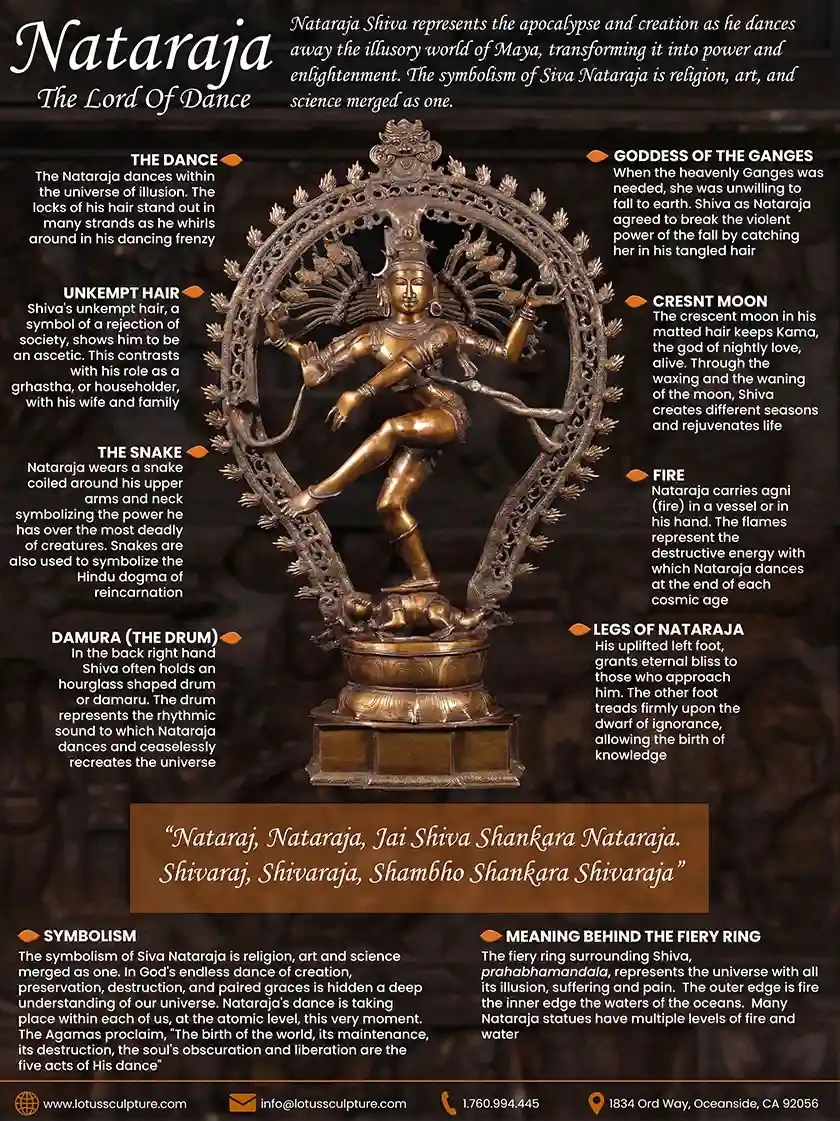
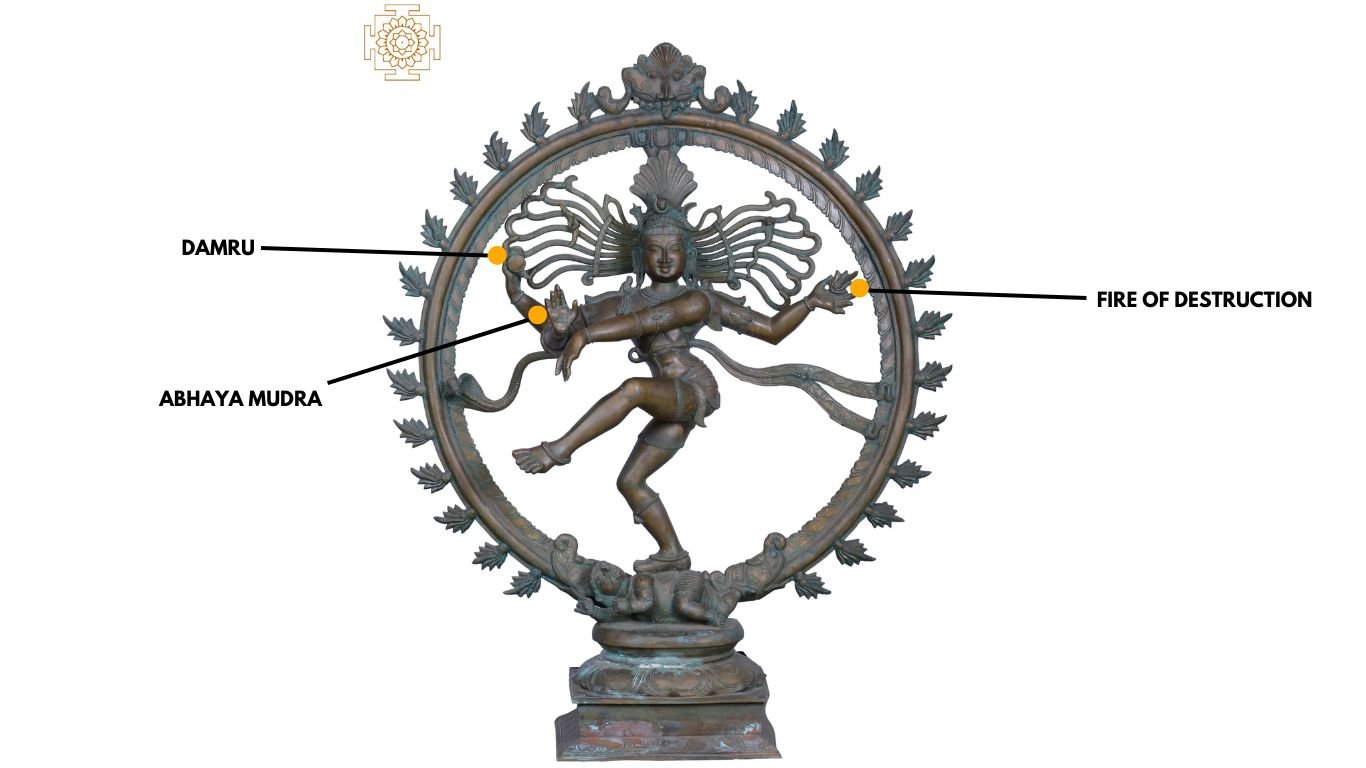
Coomaraswamy begins by rejecting any superficial interpretation of the dance as a mythological or decorative motif. The dance is not a narrative event; it is a representation of perpetual cosmic activity. Śiva dances within a circle of flames, which signifies the universe—not as a static structure but as a dynamic process of continuous creation and destruction. This circular frame, the prabhāmaṇḍala, is itself a symbol of totality: the infinite cycle within which all phenomena arise and pass away.
Each element of the image is treated as a precise symbolic articulation. The raised drum (ḍamaru) in one hand signifies creation—the primordial sound from which the universe unfolds. The flame held in another hand represents destruction, not as annihilation but as transformation, the necessary dissolution that makes renewal possible. These two gestures together articulate a fundamental rhythm: emergence and withdrawal, manifestation and return.
The gesture of reassurance (abhaya mudrā) offered by another hand introduces a different dimension. It signifies that, despite the ceaseless flux of the cosmos, there is no ultimate cause for fear. The dance, though dynamic and even violent in its imagery, is grounded in a deeper stillness. This stillness is not the absence of movement but its underlying condition—the unchanging reality within which all change occurs.
Śiva’s lifted foot, often interpreted as granting liberation, becomes in Coomaraswamy’s reading a crucial symbol of release from ignorance. Beneath the other foot lies the dwarf figure, Apasmara, representing forgetfulness or ignorance (avidyā). The act of dancing upon this figure signifies not the destruction of the world but the overcoming of illusion. The cosmos is not denied but re-seen; its apparent multiplicity is understood as the expression of a deeper unity.
One of the most striking aspects of Coomaraswamy’s interpretation is his insistence on the simultaneity of opposites. Creation and destruction, movement and stillness, terror and grace—all are present at once. The dance is not sequential but total; it encompasses all aspects of reality in a single gesture. This simultaneity reflects the non-dual metaphysics that underlies the entire book: apparent contradictions are resolved not by elimination but by integration.
The setting of the dance is also significant. Coomaraswamy emphasizes that Śiva dances in the “heart” of the devotee as much as in the cosmic arena. The image is therefore both macrocosmic and microcosmic. It describes the structure of the universe and the structure of consciousness simultaneously. The rhythm of creation and destruction is not only external but internal; it is enacted in every moment of perception, thought, and experience.
This leads to an important epistemological point. The understanding of the image is not merely intellectual. To grasp the meaning of the dance is to participate in it, to recognize oneself as part of the process it depicts. The symbol functions as a means of realization, not just representation. It invites a shift in awareness, from identification with transient forms to identification with the underlying reality.
Coomaraswamy also situates the image within a broader comparative context. He suggests that the idea of a dynamic cosmos is not unique to India, but he argues that the Indian tradition has expressed it with particular clarity and depth. The Naṭarāja image, in this sense, becomes exemplary—a model of how complex metaphysical ideas can be embodied in visual form without loss of precision.
At the same time, the essay implicitly critiques modern scientific and philosophical conceptions of the universe. While acknowledging their sophistication, Coomaraswamy suggests that they often lack a symbolic language capable of integrating knowledge with experience. The dance of Śiva, by contrast, offers a vision in which cosmology, metaphysics, and aesthetics are inseparable.
The essay thus performs multiple functions. It provides an interpretation of a specific icon, articulates a general metaphysical principle, and exemplifies the method that Coomaraswamy applies throughout the book: the reading of art as a form of knowledge. The image of the dancing Śiva becomes not only the subject of analysis but the key to understanding the entire work.
Essay 4: “The Hindu View of Art: Theory of Beauty”
In this essay, Coomaraswamy moves from symbolic exposition to a more systematic articulation of Indian aesthetic theory. The central task here is to dismantle the modern assumption that beauty is either a property of objects or a subjective reaction, and to replace it with a conception of beauty as a mode of knowledge—a state of being grounded in metaphysical realization.
He begins by confronting the dominant Western aesthetic framework, which treats art as a domain of individual expression and sensory pleasure. Within this framework, beauty is often understood as something that pleases the senses or evokes emotional response. Coomaraswamy rejects this as fundamentally inadequate. For him, such an account reduces art to psychology and ignores its intellectual and spiritual dimensions.
In the Indian tradition, as he presents it, beauty (saundarya) is inseparable from truth (satya) and knowledge (vidyā). The experience of beauty is not merely affective but cognitive; it involves a recognition of order, proportion, and meaning that reflects the underlying structure of reality. This recognition is not discursive—it does not proceed through conceptual analysis—but it is nonetheless a form of knowing. To perceive beauty is to apprehend, however fleetingly, the unity that underlies multiplicity.
This leads to a redefinition of the role of the artist. The artist is not an originator of forms in the modern sense, but a mediator who brings into manifestation pre-existing principles. Artistic creation is governed by rules, proportions, and canonical forms that are not arbitrary but rooted in a metaphysical understanding of the world. The training of the artist, therefore, is not primarily about cultivating originality but about aligning oneself with these principles.
Coomaraswamy emphasizes that this alignment requires discipline. The artist must undergo a process of self-transformation, acquiring not only technical skill but also intellectual and moral clarity. Without this preparation, the work cannot achieve its proper function. Art is thus inseparable from ethics and from what might be called spiritual practice. It is a way of knowing that demands the formation of the knower.
A key concept underlying this view is that of rasa, often translated as “flavor” or “essence.” While Coomaraswamy does not treat it in purely technical terms here, the idea is implicit in his account of aesthetic experience. The appreciation of art involves a kind of savoring that transcends ordinary emotion. It is not the personal feeling of the spectator that matters, but the evocation of a universalized experience. In this sense, art lifts the individual beyond subjective limitation and opens a space of shared meaning.
The distinction between imitation and manifestation is also central. Western aesthetics, particularly since the Renaissance, has often understood art in terms of mimesis—the imitation of nature. Coomaraswamy argues that this is not the operative principle in Indian art. The aim is not to reproduce appearances but to reveal essences. Forms are stylized, simplified, or abstracted not because of technical limitation but because the goal is to express what is permanent rather than what is contingent.
This difference is closely related to the treatment of form itself. In the Indian context, form is not merely visual but symbolic. Every element of a work—its proportions, gestures, attributes—carries meaning. These meanings are not arbitrary but grounded in a shared system of knowledge. To understand the work, therefore, requires familiarity with this system. Without it, the viewer sees only surface features and misses the deeper significance.
Coomaraswamy also addresses the question of universality. While the forms of Indian art are culturally specific, the principles they embody are not. The experience of beauty, understood as the apprehension of unity, is available to all. However, access to this experience depends on preparation. Just as the artist must be trained, so too must the spectator. Aesthetic education is thus an integral part of cultural life, not a specialized or optional activity.
The essay implicitly critiques the commodification of art in modern society. When art is treated as a luxury good or as a means of personal expression, its deeper function is obscured. The separation of art from everyday life—its confinement to galleries, markets, and private collections—reflects a broader fragmentation of experience. In traditional contexts, by contrast, art is woven into the fabric of life, present in architecture, ritual, and daily objects.
Underlying all these arguments is the same metaphysical orientation encountered earlier. Beauty is not an end in itself but a means of realization. It points beyond itself to a deeper reality, inviting the viewer to transcend the dualities of subject and object, self and world. The theory of beauty is thus inseparable from a theory of knowledge and, ultimately, from a theory of being.
In this way, the essay deepens the intellectual framework established earlier. It shows how the non-dual vision of reality is expressed not only in symbols like the dance of Śiva but also in the principles governing artistic creation and appreciation. Art becomes a privileged site where metaphysical truth is not only represented but experienced.
Essay 5: “That Beauty is a State”
In this essay, Coomaraswamy sharpens and radicalizes the argument of the previous chapter by making a decisive claim: beauty is not in the object, nor in the observer as a subjective reaction—it is a state of being. This formulation is not rhetorical; it represents a fundamental shift in how aesthetic experience is to be understood.
He begins by dismantling two dominant explanatory models. The first is objectivist: the idea that beauty inheres in the proportions, symmetry, or formal qualities of an object. The second is subjectivist: the idea that beauty is a psychological response, a feeling projected by the observer. Coomaraswamy argues that both are inadequate because they presuppose a separation between subject and object that is itself the source of confusion.
Beauty, in his account, arises precisely when this separation is overcome. It is a condition in which the perceiver and the perceived are no longer experienced as distinct. This does not mean that the object disappears, but that it is no longer apprehended as “other.” The experience of beauty is thus a moment of unity—a temporary suspension of duality. In this sense, aesthetic experience is structurally analogous to metaphysical realization.
This claim has far-reaching implications. If beauty is a state, then it cannot be located or possessed. It cannot be reduced to the qualities of a painting, a sculpture, or a landscape. These may serve as occasions for the experience, but they are not its source. The same object may appear beautiful or not, depending on the condition of the perceiver. What matters is not the object itself but the mode of awareness through which it is encountered.
Coomaraswamy illustrates this by drawing attention to the variability of aesthetic judgment. Different individuals, or even the same individual at different times, may respond differently to the same object. This variability cannot be fully explained by differences in taste or cultural conditioning. It points instead to a deeper factor: the state of consciousness. When the mind is distracted, fragmented, or self-centered, beauty is not perceived. When it is concentrated, receptive, and free of egoic interference, beauty becomes evident.
This leads to an important ethical and psychological dimension. The experience of beauty requires a certain discipline of attention. It involves a suspension of personal desire and aversion, a letting go of the impulse to appropriate or judge. In this sense, aesthetic experience is not passive but active; it demands effort, training, and self-transformation. The cultivation of aesthetic sensitivity is therefore inseparable from the cultivation of character.
The essay also clarifies the relationship between beauty and pleasure. While aesthetic experience is often pleasurable, Coomaraswamy insists that pleasure is not its defining feature. Pleasure can be derived from many sources that have nothing to do with beauty. Conversely, the experience of beauty may involve elements that are not conventionally pleasant—intensity, even a kind of austerity. What distinguishes it is not the quality of feeling but the structure of awareness.
A further implication concerns the universality of beauty. If beauty is a state, then it is not bound to particular objects or cultural forms. It is potentially accessible in any context, provided the appropriate condition of awareness is present. This does not negate the importance of artistic traditions, but it relativizes their exclusivity. The same state that is evoked by a temple sculpture may also be evoked by a natural scene, a piece of music, or even a moment of silence.
At the same time, Coomaraswamy does not collapse all distinctions. Certain forms are more conducive to the experience of beauty because they are designed in accordance with principles that reflect the underlying order of reality. Traditional art, shaped by such principles, functions as a more reliable vehicle for aesthetic realization. Modern art, insofar as it is detached from these principles, may still produce effects, but these are less stable and less oriented toward unity.
The essay culminates in a subtle but significant identification: the state of beauty is closely related to the state of liberation. Both involve the dissolution of the ego and the realization of unity. The difference lies in degree and permanence. Aesthetic experience is typically transient, a glimpse rather than a sustained realization. Nevertheless, it serves as an indication, a hint of what is possible.
In this way, Coomaraswamy integrates aesthetics into the larger metaphysical framework of the book. Beauty is not an isolated phenomenon but a manifestation of the same principle that underlies all reality. To understand beauty is therefore to approach an understanding of the self—not the empirical self, but the deeper identity that transcends individuality.
The essay thus completes a conceptual movement begun earlier. From art as symbolic knowledge, to beauty as cognitive experience, and now to beauty as a state of being, Coomaraswamy progressively dissolves the boundaries between aesthetics, epistemology, and metaphysics. What remains is a unified vision in which the experience of beauty is inseparable from the realization of truth.
Essay 6: “Buddhist Primitives”
In this essay, Coomaraswamy turns to early Buddhist art—particularly what modern scholarship had labeled “primitive”—in order to challenge the very criteria by which such judgments are made. The term “primitive,” as used in Western art history, implies a stage of technical or conceptual immaturity, a preliminary phase leading toward more refined and naturalistic representation. Coomaraswamy’s aim is to dismantle this evolutionary assumption and to show that what appears “primitive” is in fact deliberate, sophisticated, and governed by principles entirely different from those of later Western realism.
He begins by examining the absence of anthropomorphic representations of the Buddha in early art. Instead of depicting the Buddha in human form, early Buddhist artists used symbols: the Bodhi tree, the empty throne, the footprint, the wheel. From a Western perspective, this absence was often interpreted as a limitation—a lack of skill or confidence in representing the human figure. Coomaraswamy rejects this interpretation outright. The avoidance of figural representation is not due to incapacity but to principle. It reflects a metaphysical understanding of the Buddha not as a person in the ordinary sense, but as an awakened state that transcends individual form.
The symbolic mode of representation is therefore not inferior but more precise. A symbol such as the empty throne does not depict the Buddha; it signifies the presence that cannot be reduced to a bodily image. In this sense, the so-called “primitive” art is more faithful to the doctrinal content it seeks to express. It avoids the risk of reifying the Buddha into a mere historical individual and instead points to the universal dimension of enlightenment.
Coomaraswamy extends this argument by analyzing the formal qualities of early Buddhist reliefs. These works often display a stylization and abstraction that differ markedly from later naturalistic traditions. Figures are arranged according to compositional and symbolic considerations rather than optical realism. Perspective is not used to create the illusion of depth but to organize meaning. What matters is not how things appear to the eye but how they relate within a conceptual and spiritual framework.
This leads to a broader critique of naturalism. The Western valorization of lifelike representation is, for Coomaraswamy, historically contingent and philosophically limited. It privileges the sensory appearance of things at the expense of their underlying significance. In contrast, the stylization found in early Buddhist art is a means of abstraction, a way of stripping away incidental details in order to reveal essential forms. Far from being naive, it is a disciplined and intentional practice.
The essay also addresses the transition from symbolic to anthropomorphic representation in later Buddhist art. Coomaraswamy does not present this as a simple progression from “primitive” to “advanced,” but as a shift in emphasis. The later depiction of the Buddha in human form reflects changing devotional and cultural needs, including the desire for a more personal and accessible image. However, this shift also introduces new risks: the possibility of misunderstanding the Buddha as merely a historical figure rather than a transcendent principle.
In this context, Coomaraswamy’s analysis becomes implicitly methodological. He is not only interpreting Buddhist art but also critiquing the frameworks through which it has been studied. Western art history, with its emphasis on stylistic development and technical progress, is shown to be inadequate for understanding traditions that operate according to different principles. The categories of “primitive” and “advanced” are revealed as projections rather than objective descriptions.
A significant undercurrent in the essay is the idea of intentionality. Every aspect of early Buddhist art—the choice of symbols, the mode of representation, the organization of space—is governed by a conscious intention aligned with doctrinal and metaphysical concerns. To appreciate these works requires a corresponding shift in the viewer’s perspective. One must learn to see not in terms of illusionistic accuracy but in terms of symbolic coherence.
The essay also reinforces the broader theme of the book: the inseparability of art and knowledge. Early Buddhist art is not decorative or illustrative; it is didactic in the deepest sense. It communicates insights about the nature of reality, the path to liberation, and the status of the enlightened being. These insights are encoded in visual form, requiring interpretation but also inviting direct, non-discursive understanding.
In concluding, Coomaraswamy effectively reverses the evaluative hierarchy implied by the term “primitive.” What has been dismissed as rudimentary is revealed as conceptually rigorous and spiritually attuned. The apparent simplicity of early Buddhist art conceals a high degree of sophistication, one that becomes visible only when approached with the appropriate conceptual tools.
Thus, the essay not only rehabilitates a particular body of art but also advances a larger argument about the nature of artistic value. It challenges the universality of Western criteria and insists on the necessity of understanding each tradition on its own terms. In doing so, it deepens the reader’s engagement with the central thesis of the book: that art, when properly understood, is a vehicle of knowledge grounded in a coherent metaphysical vision.
Essay 7: “Indian Images”
With this essay, Coomaraswamy turns explicitly to the ontology of images—the nature of what an image is within the Indian tradition. Having already dismantled Western assumptions about representation and aesthetic autonomy, he now constructs a positive account: the image (mūrti) as a living, operative form, inseparable from ritual, metaphysics, and disciplined making.
He begins by confronting a persistent misunderstanding: that Indian images are “idols,” objects worshipped as if they were themselves divine. This, he argues, is a category error produced by a failure to grasp the symbolic and ontological status of the image. The image is not God, nor is it merely a representation of God. It is a support (pratiṣṭhā)—a locus in which the divine presence is made accessible under specific conditions.
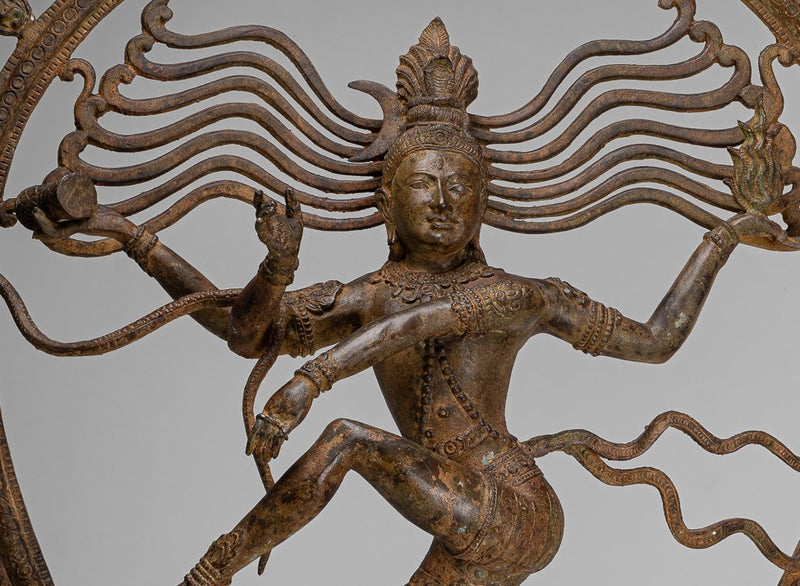


This distinction depends on a broader metaphysical premise: that reality is not divided between the sacred and the profane in an absolute sense. The divine is immanent in all things, but not equally manifest. The image is a form in which this presence is intensified and made perceptible. Its efficacy depends not only on its material form but on the rites through which it is consecrated and maintained. Without these rites, it is merely an object; with them, it becomes a center of power.
Coomaraswamy emphasizes that the making of an image is governed by strict canons. These canons are not arbitrary rules but expressions of metaphysical principles. Proportions, gestures, attributes—all are determined according to texts and traditions that encode a vision of the divine form. The artist does not invent but realizes. His task is to bring into material existence a form that already exists in a higher, intelligible order.
This process is inseparable from discipline. The artist must be trained not only technically but spiritually. The act of making is itself a form of knowledge, requiring concentration, purity, and adherence to prescribed methods. In this sense, the image is not simply produced; it is generated through a process that aligns human activity with cosmic order.
The essay also addresses the question of likeness. Unlike Western portraiture, Indian images are not concerned with capturing the appearance of a particular individual. Even when depicting historical or mythological figures, the aim is not resemblance but typification. The form expresses an essence rather than an appearance. This is why figures may appear stylized or idealized: they are not intended to replicate the visible world but to reveal a deeper reality.
Coomaraswamy further explores the role of ritual in activating the image. The ceremony of consecration (prāṇa-pratiṣṭhā) is particularly significant. Through this rite, the image is “animated,” not in a literal sense but in a metaphysical one. It becomes a site where the divine presence is acknowledged and engaged. The rituals that follow—offerings, gestures, recitations—are not acts of superstition but forms of communication within a shared symbolic language.
This leads to a reconsideration of worship itself. Worship is not directed toward the material object but toward the reality it mediates. The image serves as a focal point, enabling the practitioner to concentrate and to enter into relation with the divine. The process is reciprocal: the devotee approaches the image, and the image, as a consecrated form, responds by making presence available.
The essay also touches on the relationship between permanence and impermanence. Some images are made to endure, installed in temples and maintained over long periods. Others, such as those created for specific festivals, are deliberately temporary. Both types are valid because the value of the image does not lie in its material persistence but in its function. The destruction or immersion of a temporary image does not negate its significance; it completes its cycle.
Coomaraswamy’s analysis implicitly critiques the modern museum context discussed earlier. When an image is removed from its ritual setting and placed in a gallery, its function is fundamentally altered. It may still be admired, studied, or even revered in a limited sense, but its full significance cannot be realized. The conditions that sustain its meaning—ritual, community, continuity—are absent.
At a deeper level, the essay reinforces the non-dual framework of the book. The distinction between image and reality, like that between subject and object, is not absolute. The image participates in the reality it signifies. To engage with it properly is not to mistake it for that reality, but to recognize the continuity between form and essence.
Thus, “Indian Images” extends the earlier discussions of beauty and symbolism into a concrete domain. It shows how metaphysical principles are embodied in specific practices, how knowledge is transmitted through making and ritual, and how the image functions as a bridge between the visible and the invisible. The result is a conception of art that is neither purely aesthetic nor purely religious, but integrally both—an expression of a worldview in which form, meaning, and presence are inseparable.
Essay 8: “The Aims of Indian Art”
In this essay, Coomaraswamy gathers the threads developed so far—symbolism, metaphysics, discipline, and the ontology of the image—and articulates them in terms of purpose. The question is no longer what art is, but what it is for. His answer is unequivocal: the aim of Indian art is not self-expression, nor aesthetic pleasure, nor even representation, but the communication of truth and the facilitation of realization.
He begins by opposing two conceptions of artistic purpose. The modern Western view, shaped by Romanticism and its aftermath, treats art as the expression of individual feeling or imagination. The value of a work lies in its originality, its capacity to convey the inner life of the artist. Coomaraswamy rejects this as a historically contingent and philosophically limited notion. In the Indian context, the artist’s individuality is not the source of value but something to be disciplined and, in a sense, effaced.
The alternative he presents is a functional conception of art. Every work has a purpose, and this purpose is determined by its place within a larger order. A temple sculpture, a ritual vessel, a painted manuscript—all are designed to serve specific ends, whether liturgical, didactic, or contemplative. These ends are not external impositions but intrinsic to the form of the work itself. To understand a work of art is therefore to understand its function.
This functional orientation is inseparable from a metaphysical aim. Art is a means of knowledge, but not in the sense of conveying information. It communicates through form, symbol, and proportion, enabling the viewer to apprehend truths that cannot be expressed discursively. The ultimate aim is to lead the mind beyond itself, toward a realization of unity. In this sense, art participates in the same project as philosophy and religion.
Coomaraswamy emphasizes that this aim requires a shared framework. The meaning of a work is not invented by the viewer but discovered within a tradition. Symbols, gestures, and forms have established meanings that are transmitted through education and practice. This does not eliminate interpretation, but it situates it within limits. The viewer is not free to impose arbitrary meanings; understanding is a matter of alignment with the intention embedded in the work.
The role of discipline appears again, now in both artist and spectator. The artist must adhere to canonical forms, not as constraints but as vehicles of truth. Innovation, when it occurs, takes place within these limits and is judged by its fidelity to underlying principles. The spectator, likewise, must cultivate the capacity to perceive meaning beyond surface appearance. Without this preparation, the work remains opaque or is reduced to mere decoration.
A significant aspect of the essay is the rejection of the dichotomy between sacred and secular art. In the Indian context, all art is potentially sacred because all activity can be oriented toward realization. The distinction lies not in the object but in its use and intention. A utilitarian object, if made and used in accordance with proper principles, participates in the same order as a temple image. This collapses the hierarchy that elevates “fine art” above “craft” and restores a unity of production.
Coomaraswamy also addresses the question of pleasure. While acknowledging that art can be enjoyable, he insists that pleasure is incidental, not essential. The true aim is transformation—of perception, of understanding, and ultimately of being. Pleasure may accompany this process, but it is not its measure. To judge art primarily by the pleasure it provides is to misunderstand its purpose.
The essay implicitly critiques modern art institutions and markets. When art is produced for sale, display, or personal acclaim, its function is altered. It becomes detached from the conditions that give it meaning and is evaluated according to criteria—novelty, market value, critical reception—that are extrinsic to its true aim. This does not render modern art invalid, but it places it in a different category, one that Coomaraswamy sees as limited.
Underlying the entire discussion is a consistent teleology. Art is ordered toward an end that transcends the artwork itself. It is a means, not an end. This does not diminish its importance; on the contrary, it elevates it by situating it within the highest human concern: the realization of truth. The value of art lies precisely in its capacity to serve this end.
In this way, “The Aims of Indian Art” consolidates the philosophical position developed across the book. It clarifies that the unity of art, knowledge, and life is not merely descriptive but normative. Art ought to function as a bridge between the visible and the invisible, guiding the mind from multiplicity to unity. When it fulfills this function, it achieves its true purpose; when it does not, it becomes something else—interesting, perhaps, but ultimately incomplete.
The essay thus provides a decisive statement of Coomaraswamy’s aesthetic philosophy: art as disciplined making, grounded in tradition, oriented toward truth, and integrated into the totality of life.
Essay 9: “Rajput Painting”
In this essay, Coomaraswamy turns to a specific artistic tradition—Rajput painting—in order to demonstrate how the principles he has outlined operate within a concrete historical form. Rather than treating these paintings as merely decorative or courtly artifacts, he interprets them as visual expressions of a highly refined symbolic and emotional discipline, grounded in metaphysical and aesthetic theory.

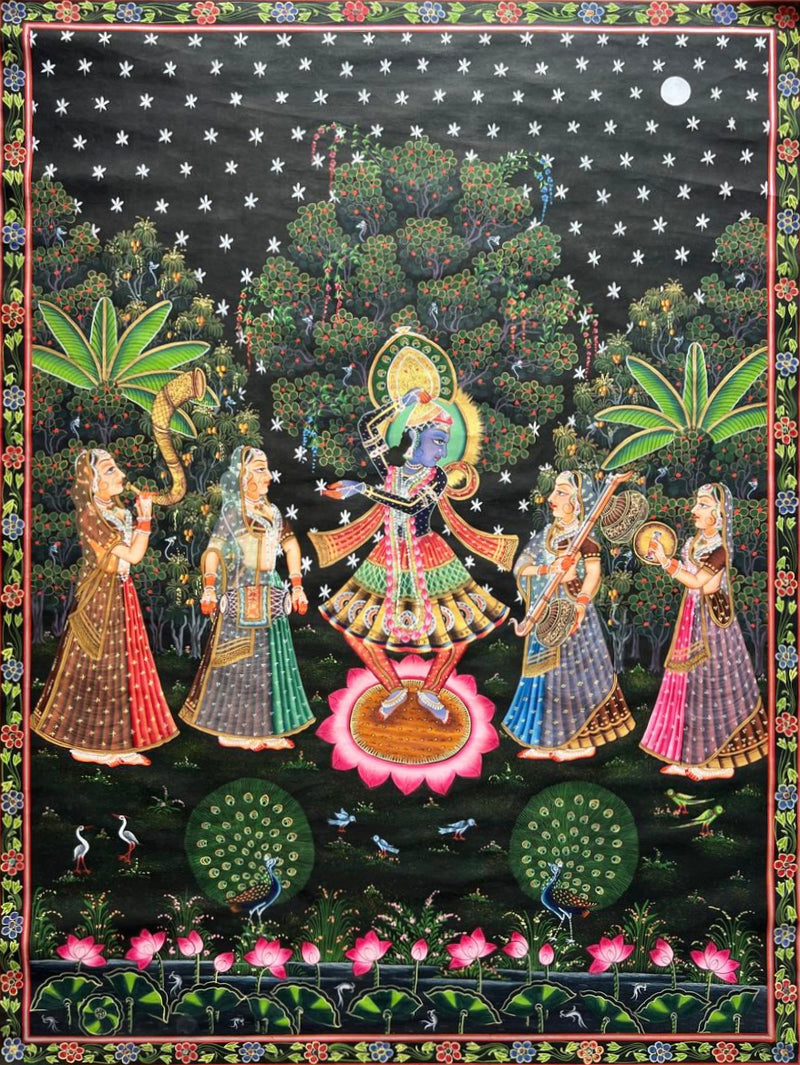
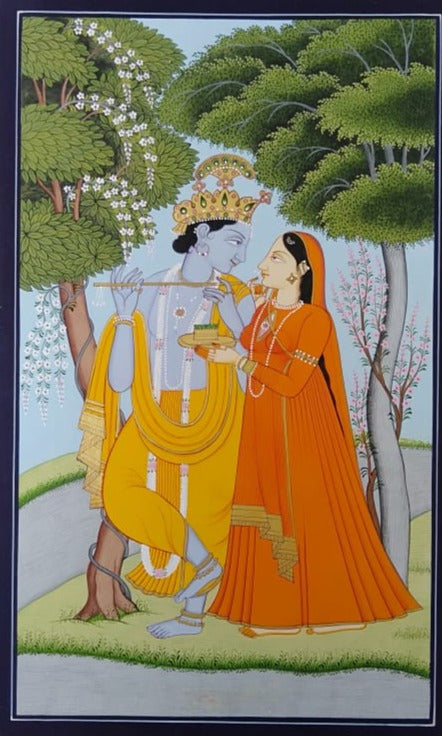
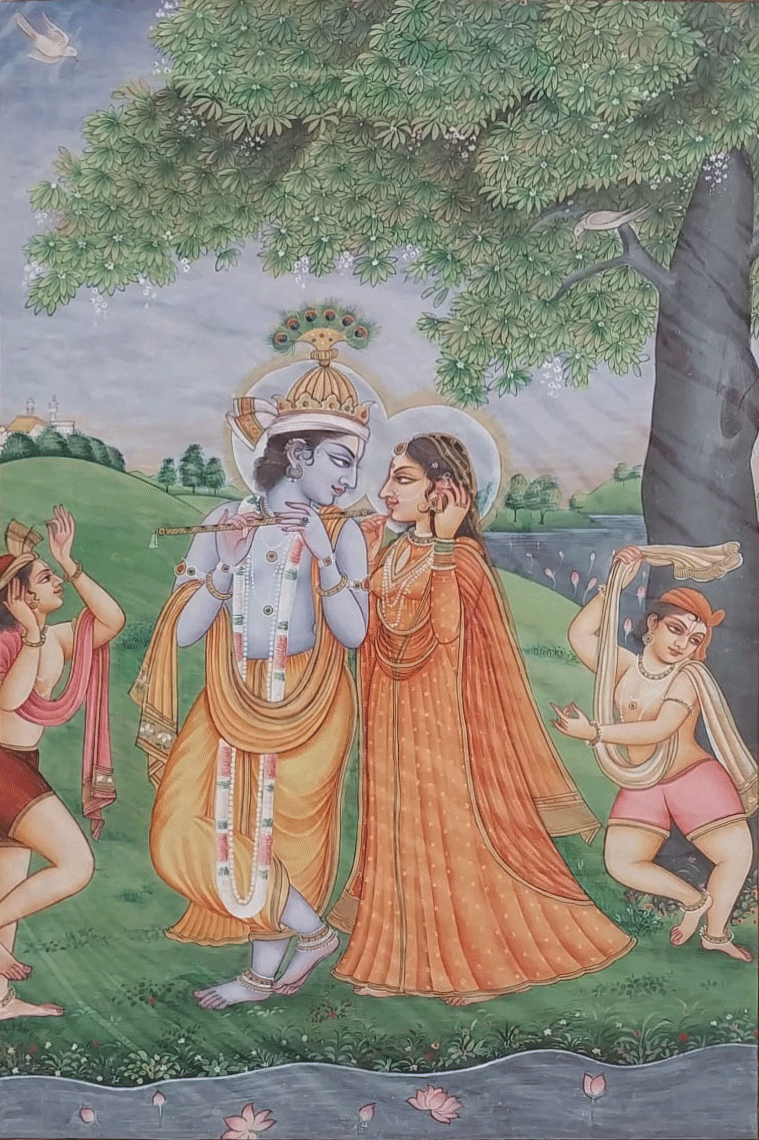
He begins by addressing a common misreading: that Rajput paintings are naive, lacking in perspective, anatomical accuracy, or naturalistic detail. From the standpoint of Western academic art, these features appear as deficiencies. Coomaraswamy reverses this evaluation. The apparent “distortions” are intentional, governed by a different set of priorities. The aim is not to reproduce visual reality but to render an inner state—emotional, symbolic, and spiritual.
Central to this rendering is the concept of bhāva, the emotional or psychological condition that underlies aesthetic experience. Rajput paintings are not illustrations of events but crystallizations of states of feeling. Whether depicting the love of Rādhā and Kṛṣṇa, the longing of a heroine, or the mood of a particular season, the painting seeks to evoke a specific rasa—a distilled emotional essence that transcends individual circumstance.
The treatment of space and form reflects this aim. Perspective, as developed in Renaissance Europe, creates the illusion of a continuous, three-dimensional space. Rajput painting, by contrast, organizes space symbolically. Elements are arranged according to their significance rather than their optical relation. Backgrounds may be flattened, colors intensified, and proportions altered in order to emphasize meaning over appearance. The result is not a lack of realism but a different realism—one that pertains to experience rather than perception.
Color plays a particularly important role. Coomaraswamy notes that colors are not chosen to imitate nature but to express mood and value. A night scene may be rendered in deep blues not because it looks that way to the eye, but because it conveys the emotional and symbolic qualities associated with night—mystery, intimacy, longing. Similarly, the use of gold, red, or green is governed by conventions that link color to meaning.
The figures themselves are stylized, often sharing similar facial features and bodily forms. This uniformity is not a failure of observation but a deliberate abstraction. Individual identity is subordinated to type, allowing the viewer to focus on the state being represented rather than the particularities of a person. The figures become vehicles of expression rather than subjects of portraiture.
Coomaraswamy also situates Rajput painting within its literary and musical context. Many of these works are directly related to poetic traditions, especially those centered on devotional and romantic themes. The imagery often corresponds to specific verses, seasons, or musical modes (rāgas). This interrelation underscores the integrative nature of Indian art: painting, poetry, and music are different manifestations of the same underlying sensibility.
The devotional dimension is particularly significant. The love depicted in these paintings—especially that of Rādhā and Kṛṣṇa—is not merely human romance but a symbolic representation of the soul’s relation to the divine. The emotional intensity of longing, separation, and union becomes a means of expressing spiritual aspiration. The aesthetic experience thus opens onto a religious one, without losing its formal integrity.
At the same time, Coomaraswamy resists reducing the paintings to allegory. They are not simply coded messages that can be translated into doctrinal statements. Their meaning is experiential, conveyed through the total configuration of form, color, and composition. To understand them requires not only intellectual knowledge but a cultivated sensitivity to their aesthetic language.
The essay also implicitly critiques the Western tendency to isolate artworks from their context. Rajput paintings are often studied as individual objects, but in their original setting they were part of albums, sequences, or performances. Their full significance emerges only when seen in relation to these contexts, where narrative, mood, and variation can unfold over time.
In concluding, Coomaraswamy presents Rajput painting as a paradigmatic example of what he has been arguing throughout the book. It is an art that does not seek to imitate the world but to reveal its deeper structure; that does not express individual emotion but universalized feeling; and that does not exist for its own sake but as part of a larger, integrated vision of life.
Thus, the essay serves both as a case study and as a reaffirmation. It shows that the principles of Indian aesthetics are not abstract theories but living realities, embodied in specific traditions. Through Rajput painting, one sees how form, emotion, and metaphysics converge, producing works that are at once sensuous and symbolic, immediate and transcendent.
Essay 10: “Individuality, Autonomy, and Function”
In this essay, Coomaraswamy addresses one of the most decisive points of divergence between modern Western and traditional Indian thought: the status of the individual. Where modernity elevates individuality, autonomy, and personal expression as primary values, the Indian tradition, as he interprets it, situates the individual within a larger order defined by function (svadharma) and metaphysical orientation.
He begins by examining the modern concept of individuality. In the Western context, particularly since the Renaissance and Enlightenment, the individual is conceived as an autonomous center of experience and action. Creativity, originality, and self-expression are taken as signs of value. In the arts, this manifests as the cult of the artist-genius, whose work is judged by its uniqueness and personal vision.
Coomaraswamy challenges this conception at its root. He argues that what is commonly called “individuality” is often nothing more than the assertion of ego—the identification of the self with its particular desires, preferences, and experiences. This form of individuality, far from being a mark of freedom, is a limitation. It binds the person to the contingent and the transient, preventing access to the universal.
In contrast, the traditional Indian view distinguishes between the empirical self and a deeper principle of identity. The true self is not the individual personality but that which transcends it—the same reality that underlies all beings. From this perspective, the goal is not to assert individuality but to transcend it, to realize a unity that is prior to all differentiation.
This metaphysical orientation has direct implications for social organization. The concept of svadharma—one’s proper function or duty—becomes central. Each individual is understood to have a role determined by a combination of inherent disposition and social context. This role is not arbitrary but part of a larger order. To fulfill one’s function is to participate in the harmony of the whole.
Coomaraswamy is careful to emphasize that this is not a denial of difference. Individuals are not identical; they differ in capacity, inclination, and responsibility. However, these differences are not grounds for competition or self-assertion. They are expressions of a functional diversity that contributes to the unity of the system. Value is measured not by personal achievement but by the degree to which one fulfills one’s role in accordance with principle.
The essay then turns to the arts, where this contrast becomes particularly visible. In traditional Indian art, the artist does not seek to express a personal vision but to realize a form that is already given within the tradition. The work is not signed, and the identity of the maker is often irrelevant. What matters is the correctness of the form and its alignment with established principles.
This anonymity is not a lack but a condition of possibility. By subordinating personal expression, the artist becomes a transparent medium through which universal forms can be manifested. The elimination of ego is not a suppression but a liberation; it allows for a higher level of precision and meaning. The work is not diminished by the absence of individuality; it is intensified.
Coomaraswamy contrasts this with modern art, where the emphasis on originality often leads to fragmentation. When each artist seeks to be unique, there is no longer a shared framework within which meaning can be stabilized. The result is a proliferation of styles and interpretations, but also a loss of coherence. Art becomes subjective, its value dependent on personal or cultural preference rather than on objective principles.
The notion of autonomy is also scrutinized. In modern thought, autonomy is associated with freedom—the ability to act independently of external constraints. Coomaraswamy argues that this conception is misleading. True freedom is not the absence of constraint but alignment with necessity. To act in accordance with one’s function is not to be constrained but to be fully actualized.
This leads to a reinterpretation of discipline. What appears as restriction from a modern perspective is, in the traditional context, a means of realization. Rules, canons, and social roles are not arbitrary impositions but structures that enable the individual to transcend limitation. Discipline is thus not opposed to freedom but constitutive of it.
The essay also has an implicit ethical dimension. The modern emphasis on rights and personal fulfillment is contrasted with a traditional emphasis on duties and responsibilities. Coomaraswamy does not deny the importance of rights, but he suggests that a society organized primarily around them risks losing a sense of shared purpose. Duty, by contrast, connects the individual to the whole and provides a framework for meaningful action.
At a deeper level, the essay reinforces the non-dual framework of the book. The opposition between individual and universal is shown to be ultimately illusory. The individual, properly understood, is a manifestation of the universal. To realize this is to overcome the tension between autonomy and function, between freedom and order.
In concluding, Coomaraswamy does not simply reject modern individuality; he redefines it. True individuality is not the assertion of difference but the realization of identity with the universal. It is not expressed through novelty but through the perfection of form and function. This conception, though radically different from modern assumptions, is presented as more coherent and more conducive to the aims of life as defined in the earlier essays.
Thus, “Individuality, Autonomy, and Function” extends the critique of modernity into the domain of the self, showing how aesthetic, social, and metaphysical principles converge in a single, integrated vision.
Essay 11: “Art and Swadeshi”
In this essay, Coomaraswamy brings his aesthetic and metaphysical framework into direct contact with the political and economic realities of colonial India. The concept of Swadeshi—associated with the nationalist movement and figures such as Mahatma Gandhi—is typically understood in economic terms: the use of indigenous goods and the rejection of foreign imports. Coomaraswamy accepts this but deepens it, arguing that Swadeshi must also be understood as a cultural and intellectual principle, especially in relation to art.
He begins by situating the crisis of Indian art within the broader effects of industrialization and colonial influence. Traditional systems of production, particularly the crafts, had been disrupted by machine-made goods and by changing patterns of consumption. Artisans who once worked within stable frameworks of patronage and tradition were now forced into conditions that devalued their skills and severed their connection to meaningful forms. The result was not only economic decline but a loss of coherence in artistic practice.
Coomaraswamy rejects the idea that this decline can be remedied simply by imitating Western models. The adoption of European academic styles, techniques, and institutions does not restore vitality; it produces a derivative art that lacks both authenticity and depth. This critique is not based on cultural chauvinism but on the recognition that artistic forms are inseparable from the metaphysical and social conditions that sustain them. To import forms without their underlying principles is to create something fundamentally incoherent.
Swadeshi, in this context, becomes a principle of alignment rather than mere preference. It calls for the recovery of indigenous modes of thought, production, and expression—not as a matter of nostalgia, but as a means of restoring continuity. This recovery is not a simple return to the past; it requires a critical understanding of tradition and its adaptation to present conditions. The goal is not replication but reactivation.
A key aspect of this reactivation is the restoration of the crafts. Coomaraswamy places particular emphasis on the dignity and importance of the artisan. In traditional society, the craftsman is not a marginal figure but a central participant in cultural life. His work is governed by principles that are both technical and symbolic, and it contributes to the overall harmony of the environment. The decline of the crafts is therefore not merely an economic issue but a cultural and spiritual one.
He contrasts this with industrial production, which prioritizes efficiency, uniformity, and profit. While acknowledging the practical advantages of machinery, Coomaraswamy argues that it cannot replace the qualitative dimension of handcrafted work. Machine-made objects lack the intentionality and symbolic resonance of traditional crafts. They are designed for use and consumption, not for participation in a larger order of meaning.
The essay also addresses the role of education. Coomaraswamy criticizes the colonial education system for promoting Western categories of thought at the expense of indigenous knowledge. Students are trained to value foreign models and to disregard their own traditions. This creates a form of cultural alienation, in which individuals are disconnected from the very resources that could sustain a meaningful artistic practice.
Swadeshi, therefore, requires a transformation of education. It involves the reintegration of traditional knowledge systems into the curriculum, including the study of texts, techniques, and principles that underlie Indian art. This is not an anti-intellectual stance; on the contrary, it demands a rigorous engagement with tradition, informed by both scholarship and practice.
Coomaraswamy is careful to distinguish his position from narrow nationalism. Swadeshi is not about rejecting all foreign influence or asserting cultural superiority. It is about grounding oneself in a coherent framework. Only from such a position can genuine dialogue with other cultures take place. Without it, engagement becomes imitation or assimilation.
The essay also has an implicit ethical dimension. The choice to support indigenous production is not merely economic but moral. It reflects a commitment to sustaining communities, preserving knowledge, and maintaining a balance between human activity and its environment. Consumption, in this sense, becomes an ethical act, connected to broader questions of responsibility and purpose.
At a deeper level, the essay reinforces the central theme of integration. Art, economy, education, and metaphysics are not separate domains but interrelated aspects of a single system. The disruption of one affects the others. The restoration of art, therefore, cannot be achieved in isolation; it requires a broader reorientation of society.
In concluding, Coomaraswamy presents Swadeshi as both a critique and a program. It critiques the dislocations produced by colonialism and industrial modernity, and it proposes a path toward recovery grounded in tradition and principle. This path is not easy, nor is it purely restorative. It demands a rethinking of values, a reorganization of institutions, and a renewed commitment to the integration of knowledge and life.
Thus, “Art and Swadeshi” extends the argument of the book into the domain of praxis. It shows how the principles articulated in earlier essays can inform concrete action, linking metaphysical insight with cultural and economic renewal.
Essay 12: “The Village Community and Modern Progress”
In this essay, Coomaraswamy shifts his focus from art in the narrow sense to the broader social organism within which art is embedded: the traditional Indian village. The village community is not treated as a mere economic unit or a relic of the past, but as a living structure that embodies the same principles of integration, function, and metaphysical orientation that he has traced in art and symbolism.
He begins by challenging the modern narrative of progress. Industrialization, urbanization, and centralized political organization are typically presented as markers of advancement. The village, by contrast, is often depicted as backward, stagnant, or inefficient. Coomaraswamy questions this evaluative framework, arguing that it is based on a narrow understanding of human welfare—one that prioritizes material production and administrative control over coherence and meaning.
The traditional village, in his account, is characterized by a high degree of functional integration. Different occupations—agriculture, craft, ritual, governance—are distributed among members of the community in a way that ensures both economic sustainability and social cohesion. This distribution is not random but structured according to principles analogous to those governing artistic production: each role has its place, and the value of each is determined by its contribution to the whole.
This structure allows for a form of decentralization that contrasts sharply with modern systems. The village is largely self-sufficient, capable of meeting its basic needs without reliance on distant markets or centralized institutions. This autonomy is not absolute, but it provides a degree of resilience and stability that is often lacking in more complex systems.
Coomaraswamy emphasizes that this organization is not merely economic but cultural. The village is a site of continuous transmission of knowledge—technical, artistic, and spiritual. Crafts are learned through apprenticeship, rituals are maintained through collective practice, and values are reinforced through shared participation. The separation between work, art, and religion, so characteristic of modern life, does not exist here.
At the same time, he acknowledges that the village is not a utopia. It has its own limitations and inequities, and it is subject to historical change. However, these limitations do not justify the wholesale replacement of the system by industrial modernity. The question, for Coomaraswamy, is not whether the village is perfect, but whether the alternative offers a more coherent and meaningful form of life.
The critique of modern progress becomes sharper as he examines its consequences. Industrialization, while increasing production, often leads to the disintegration of communities, the degradation of labor, and the loss of traditional knowledge. Urbanization concentrates populations in environments that are economically efficient but socially and psychologically fragmented. The individual, detached from stable roles and relationships, becomes both more mobile and more isolated.
This fragmentation has direct implications for art. When the social framework that sustains artistic practice is disrupted, art itself becomes detached from life. Crafts decline, symbolic languages are forgotten, and artistic production becomes either commodified or marginal. The loss of the village, in this sense, is also the loss of a living context for art.
Coomaraswamy also addresses the ideological dimension of progress. The belief in continuous improvement, driven by technological and economic development, creates a temporal orientation that devalues the past. Tradition is seen as an obstacle rather than a resource. This orientation, he suggests, leads to a form of amnesia, in which societies lose contact with the principles that once guided them.
Against this, he proposes a different conception of continuity. Change is not rejected, but it is understood as transformation within a stable framework of principles. The village, as an institution, may evolve, but its underlying logic—functional integration, local autonomy, and metaphysical orientation—can be preserved. The challenge is to adapt these principles to new conditions without losing their coherence.
The essay also implicitly connects with the earlier discussion of Swadeshi. The revitalization of local production, the support of crafts, and the revaluation of indigenous knowledge are all linked to the preservation of the village structure. Economic choices become cultural choices, and both are tied to broader questions of meaning and purpose.
At a deeper level, the village community is presented as a microcosm of the larger metaphysical order. Just as the cosmos is an integrated whole in which each element has its function, so too is the village. This analogy reinforces the central thesis of the book: that social, artistic, and metaphysical structures are not separate but homologous.
In concluding, Coomaraswamy does not call for a simple return to village life, nor does he deny the realities of modern change. Rather, he invites a reconsideration of the values that guide such change. Progress, if it is to be meaningful, must be measured not only in terms of material output but in terms of coherence, integration, and the capacity to sustain a meaningful form of life.
Thus, “The Village Community and Modern Progress” extends the scope of the book to encompass the totality of social existence. It shows that the questions raised in relation to art—function, meaning, discipline, unity—are equally applicable to the organization of society. The fate of art and the fate of the community are, in this view, inseparable.
Essay 13: “The Dance of Śiva (Conclusion and Reaffirmation)”
The final movement of the book does not introduce a new domain but returns, with greater clarity and compression, to the central symbol with which it is most closely identified: the dance of Shiva. If the earlier essay on Naṭarāja offered an interpretive exposition, this concluding gesture functions as a philosophical consolidation. It gathers the dispersed arguments—about art, society, individuality, symbolism, and knowledge—into a single, unifying image.
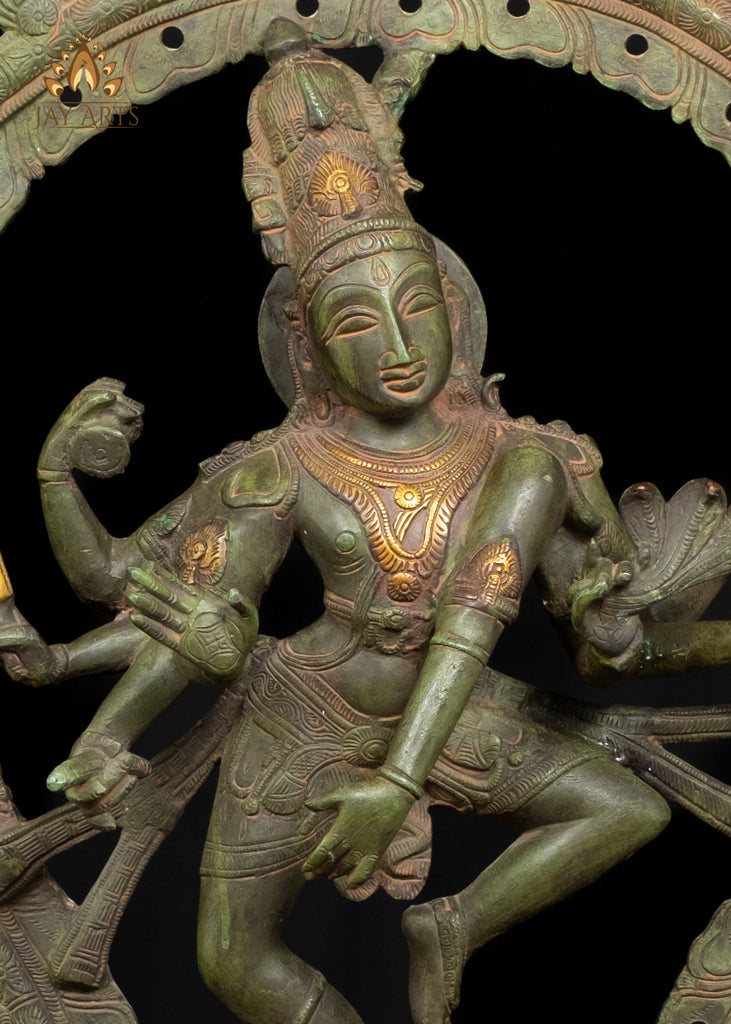
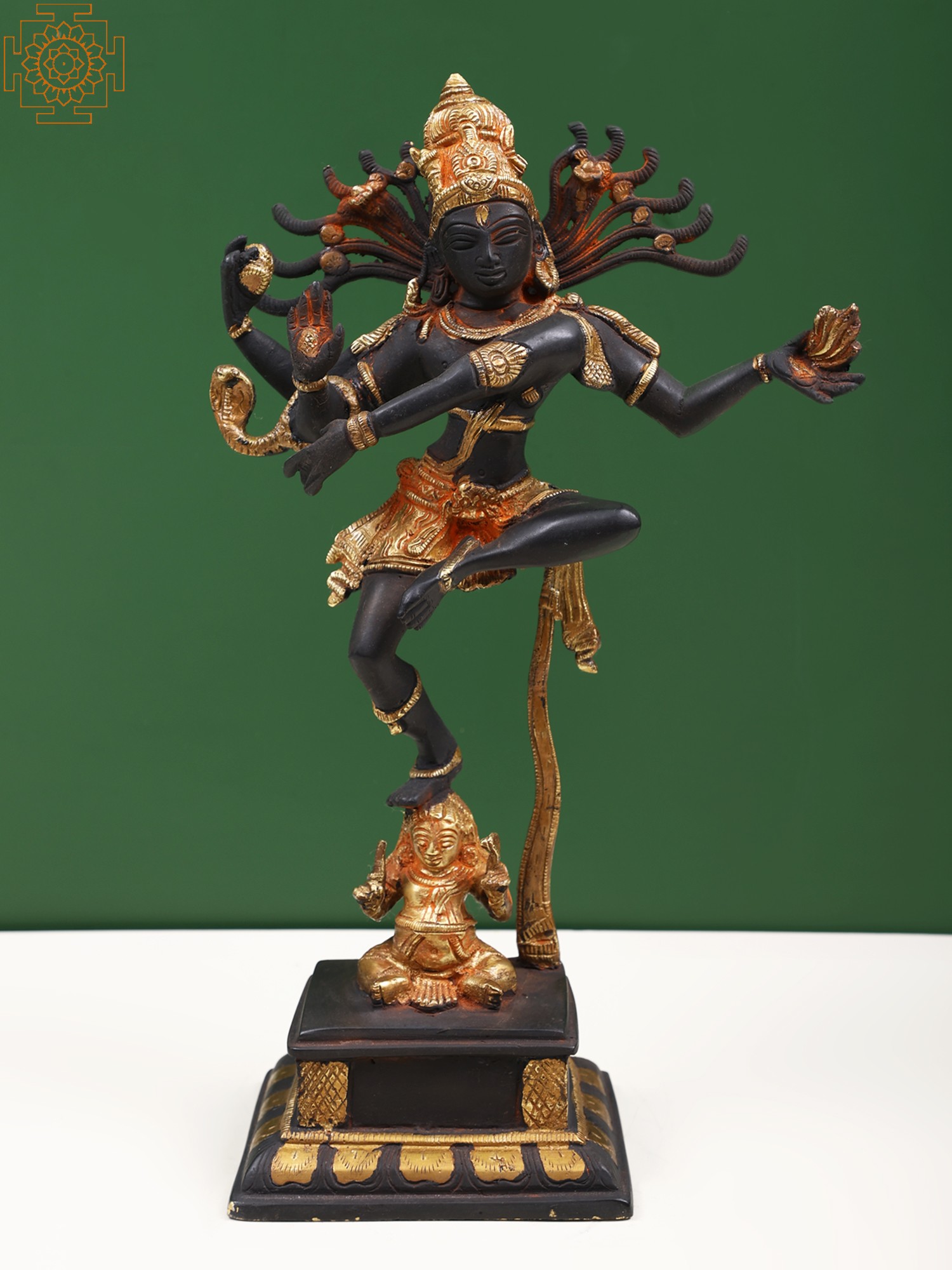
Coomaraswamy reiterates that the dance is not to be understood as a mythological episode but as a permanent condition of reality. The cosmos is not a static creation but a continuous process—an unceasing rhythm of manifestation and withdrawal. The dance is therefore eternal, occurring at every moment and at every level of existence. It is as much the structure of consciousness as it is the structure of the universe.
What distinguishes this final treatment is its emphasis on integration. The various dualities that have been examined throughout the book—subject and object, individual and universal, art and life, tradition and change—are now seen as aspects of a single dynamic. The dance does not resolve these dualities by eliminating one side or the other; it holds them together in a higher unity. Creation and destruction, for instance, are not opposed processes but complementary movements within the same rhythm.
The image of stillness within motion becomes particularly significant here. Śiva’s dance is vigorous, even violent, yet it is grounded in an absolute stillness. This paradox mirrors the metaphysical claim that the ultimate reality is unchanging, even as it manifests as change. The world of multiplicity is not denied but understood as the expression of an underlying unity that remains unaffected by its own activity.
Coomaraswamy also returns to the figure of Apasmara, the dwarf of ignorance beneath Śiva’s foot. In this concluding context, ignorance is not merely a lack of knowledge but a misperception of reality—a failure to recognize the unity underlying diversity. The act of dancing upon Apasmara signifies the overcoming of this misperception. Liberation is not the destruction of the world but the correction of vision.
The role of art, as developed throughout the book, is now implicitly redefined in light of this symbol. Art is a means by which the structure of the dance becomes perceptible. Through form, proportion, and symbol, it makes visible what is otherwise hidden. The Naṭarāja image is exemplary not because it is unique, but because it achieves this function with exceptional clarity.
At the same time, the conclusion extends beyond art. The dance is not confined to images or rituals; it is the pattern of all existence. Social organization, ethical action, and individual realization are all expressions of the same underlying rhythm. To live rightly is to align oneself with this rhythm, to participate consciously in the dance rather than to resist or misunderstand it.
There is also a subtle shift in tone. While earlier essays often adopt a critical stance toward modernity, the conclusion is less polemical and more contemplative. The emphasis is on vision rather than critique. The reader is invited not merely to understand but to see—to recognize the dance in the world and in oneself.
Coomaraswamy’s final gesture is thus both philosophical and experiential. He does not conclude with a summary of arguments but with a re-presentation of the central intuition in its most concentrated form. The dance of Śiva becomes a kind of lens through which all aspects of the book can be viewed and understood.
In this sense, the conclusion does not close the discussion but opens it. The symbol of the dance is inexhaustible; it can be revisited from multiple perspectives, each time revealing new dimensions. The book itself participates in this movement, offering not a final doctrine but a way of seeing.
Thus, the work ends where it began, but at a different level of understanding. What was initially presented as a cultural and artistic symbol is now revealed as a comprehensive metaphysical principle. The dance of Śiva is not simply an object of study; it is the very condition of reality, within which both the book and its reader are already situated.
Key Theses of the Book
What emerges across the essays is not a sequence of independent arguments but a tightly interwoven set of theses, each reinforcing the others from different angles. The first and most foundational of these is that reality is fundamentally unified, and that this unity is not merely a metaphysical abstraction but the ground of all meaningful human activity. Art, knowledge, social organization, and spiritual practice are not separate domains; they are differentiated expressions of a single underlying order. The fragmentation characteristic of modern life is therefore not a neutral development but a deviation from a more coherent mode of being.
From this follows the second thesis: that art is a form of knowledge. Coomaraswamy consistently rejects the reduction of art to aesthetic pleasure or personal expression. Instead, he presents it as a cognitive activity, one that communicates truths about the nature of reality through symbolic and formal means. This knowledge is not discursive but intuitive; it does not proceed through argument but through direct apprehension. The experience of art, properly understood, is thus analogous to philosophical insight or spiritual realization.
A third thesis concerns the nature of beauty. Beauty is not located in objects nor in subjective response, but in a state of being in which the division between subject and object is overcome. This state is characterized by unity, clarity, and the suspension of egoic interference. Artistic forms can facilitate this state, but they do not produce it mechanically. The experience of beauty depends on the condition of the perceiver as much as on the qualities of the work.
Closely related is the thesis that symbolism is the primary language of traditional art. Symbols are not arbitrary signs but participatory forms that embody the realities they signify. The image of Śiva as Naṭarāja is exemplary in this regard: it does not merely represent the cosmos but articulates its structure in a way that can be directly apprehended. To understand a symbol is not simply to interpret it intellectually but to enter into the mode of awareness it encodes.
Another central argument concerns the role of tradition. Coomaraswamy defends tradition as a repository of accumulated knowledge, transmitted through forms, practices, and canons. This transmission is not static but dynamic; it allows for adaptation without loss of principle. Modernity’s rejection of tradition, in favor of individual innovation and autonomy, leads to fragmentation and incoherence. The recovery of tradition is therefore not a nostalgic gesture but a necessary condition for the restoration of meaning.
The critique of individuality forms another key thesis. The modern emphasis on personal expression and autonomy is contrasted with a traditional conception of the self as fundamentally relational and ultimately identical with the universal. True individuality is not the assertion of difference but the realization of unity. In the arts, this is reflected in the anonymity of the artist and the primacy of canonical forms over personal style.
Coomaraswamy also advances a thesis about function. Every activity, including art, has a purpose that is determined by its place within a larger order. The value of a work lies in its capacity to fulfill this purpose, not in its novelty or market value. The separation of art from function, characteristic of modern aesthetics, is seen as a symptom of a broader disintegration.
A further thesis concerns the nature of society. Traditional social organization, exemplified by the village community, is understood as an integrated system in which different roles contribute to a common goal. This integration mirrors the metaphysical unity of reality. Modern forms of organization, by contrast, tend toward centralization and fragmentation, disrupting the conditions that sustain meaningful cultural practices.
The concept of Swadeshi extends these ideas into the political and economic sphere. It asserts the importance of grounding cultural production in indigenous principles and practices. This is not a rejection of all external influence but a call for coherence. Without such grounding, artistic and intellectual life becomes derivative and disconnected from its sources.
Underlying all these theses is a consistent methodological stance: that traditions must be understood on their own terms. Western categories—such as “primitive,” “aesthetic,” or “individual”—are often inadequate for interpreting non-Western forms. A proper understanding requires a shift in perspective, an openness to different conceptual frameworks.
Finally, the book advances a thesis about realization. The ultimate aim of all these domains—art, knowledge, social life—is the realization of unity, the overcoming of ignorance, and the attainment of a state in which the individual recognizes its identity with the universal. The dance of Śiva serves as the symbolic condensation of this aim, expressing in a single image the dynamic and unified nature of reality.
Taken together, these theses form a coherent vision that challenges many of the assumptions of modern thought. They do not constitute a system in the strict philosophical sense, but they are unified by a consistent orientation toward integration, participation, and realization.
Methodology Analysis
Coomaraswamy’s method in The Dance of Siva is neither purely historical nor purely philosophical; it is a hybrid mode of inquiry that deliberately resists the disciplinary boundaries characteristic of modern scholarship. At its core lies a hermeneutic of sympathy—an attempt to understand a tradition from within its own conceptual and experiential framework rather than imposing external categories upon it. This methodological stance is both the strength of the work and, in certain respects, its point of tension.
He proceeds first through what might be called a philological-symbolic method. Texts, images, and practices are treated as expressions of a shared symbolic language. Coomaraswamy frequently moves between scriptural references, artistic forms, and social structures, reading them as mutually illuminating. A sculptural gesture, a ritual act, and a philosophical doctrine are not separate data points but different articulations of the same principle. This allows him to reconstruct a coherent worldview without reducing it to any single domain.
However, his use of philology is not narrowly technical. He does not engage in exhaustive textual criticism or historical reconstruction in the manner of academic Indology. Instead, he selects and interprets material in order to reveal underlying patterns. This selective approach enables clarity and synthesis, but it also means that historical complexity is sometimes subordinated to conceptual coherence. Variations, contradictions, and developments within the tradition are less emphasized than the unity he seeks to demonstrate.
A second dimension of his method is comparative. Coomaraswamy frequently draws parallels between Indian thought and other traditions—Greek philosophy, Christian mysticism, medieval European art. These comparisons are not superficial analogies but attempts to indicate what he considers universal principles. By doing so, he positions Indian civilization not as an isolated case but as a particularly clear expression of a perennial philosophy.
Yet this comparative method is asymmetrical. It is not aimed at constructing a neutral, cross-cultural analysis, but at correcting what he perceives as Western misunderstandings. The direction of comparison often runs from India outward, using Indian categories as a standard against which others are measured. This gives the work a polemical edge: it is not only descriptive but corrective.
A third methodological feature is his integration of aesthetics and metaphysics. Unlike modern art history, which tends to focus on style, chronology, and influence, Coomaraswamy interprets art primarily in terms of meaning and function. Formal analysis is present but always subordinated to symbolic interpretation. The question is not how a work looks, but what it articulates about reality. This approach allows for profound insights into the internal logic of traditional art, but it also risks underplaying the material and historical conditions of production.
Closely related is his anti-psychological stance. Coomaraswamy consistently rejects explanations of art in terms of individual psychology—whether of the artist or the viewer. He is not interested in intention as personal expression, nor in reception as subjective response. Instead, he focuses on impersonal principles that govern both creation and perception. This aligns with his broader critique of individualism, but it also distances his method from modern approaches that emphasize context, identity, and experience.
Another important aspect is his normative orientation. Coomaraswamy does not present his analysis as neutral or purely descriptive. He evaluates, critiques, and advocates. Modern industrial society, aestheticism, and individualism are not simply described; they are judged against the standards he derives from traditional thought. This gives the work a philosophical coherence but also raises questions about objectivity. His method is explicitly value-laden, guided by a commitment to the restoration of what he sees as a lost unity.
At the same time, there is a phenomenological sensitivity in his writing. He pays close attention to the structure of experience—what it means to perceive beauty, to engage with a symbol, or to participate in a ritual. These analyses are not empirical in the modern sense, but they are grounded in careful observation of how meaning is constituted. In this respect, his work anticipates later developments in phenomenology and the study of religion.
A further methodological tension arises from his treatment of history. While he draws on historical material, he tends to subordinate temporal development to timeless principles. Traditions are presented as coherent wholes rather than as evolving and contested fields. This allows him to articulate a clear and unified vision, but it may obscure the diversity and dynamism within the traditions he discusses.
Finally, his method can be described as synthetic. Rather than building arguments step by step from empirical data, he constructs a comprehensive vision in which different elements are integrated. This synthesis is not imposed arbitrarily; it emerges from his reading of the material. However, it requires the reader to accept a certain level of abstraction and to engage with the work at a conceptual level.
In evaluating this methodology, one must recognize both its power and its limits. It is powerful in its ability to reveal connections that are often overlooked, to restore meaning to forms that have been misunderstood, and to articulate a coherent alternative to modern fragmentation. At the same time, it is limited by its selectivity, its normative stance, and its relative lack of attention to historical and social complexity.
Thus, Coomaraswamy’s method is best understood not as a model for empirical research but as a philosophical intervention. It seeks to reorient the reader’s perspective, to make visible a different way of understanding art and life. Its success lies less in the accumulation of evidence than in the clarity and depth of the vision it presents.
Quotes and Citation
“The dance of Śiva is the dancing universe; the ceaseless flow of energy going through an infinite variety of patterns.”
“Beauty is a state, not a quality of things; it arises when the subject and object are no longer divided.”
“The artist is not a special kind of man, but every man is a special kind of artist.”
“Art is the imposition of a pattern on experience, and our aesthetic enjoyment is recognition of the pattern.”
“The function of art is not to imitate nature, but to represent the universal in the particular.”
These formulations condense the central movement of Coomaraswamy’s thought: from the symbolic vision of the cosmos, to the epistemological status of beauty, to the social and ethical implications of artistic practice. Each quote is less an isolated insight than a node within the larger network of ideas developed across the essays.
Closing Comments
What ultimately distinguishes The Dance of Siva is not the range of its subject matter but the consistency of its vision. Coomaraswamy is not merely describing Indian art or culture; he is articulating an alternative way of understanding reality—one in which knowledge, beauty, action, and being are inseparable. The essays, though varied in topic, converge upon a single insight: that fragmentation is not the natural condition of human life but a deviation from a more integrated mode of existence.
The force of the book lies in its refusal to accept the categories of modernity as given. Terms such as “art,” “individual,” “progress,” and even “beauty” are subjected to a radical rethinking. In their place, Coomaraswamy offers a framework grounded in unity, function, and realization. This framework is not presented as uniquely Indian in an exclusive sense, but as a particularly clear articulation of principles that may be universally accessible.
At the same time, the work is not without its tensions. Its commitment to unity can sometimes lead to an underemphasis on historical variation and internal diversity. Its critique of modernity, while often incisive, may appear uncompromising. Yet these tensions are inseparable from its ambition. Coomaraswamy is not writing as a detached observer but as a thinker engaged in a civilizational dialogue, seeking to recover what he sees as a lost coherence.
For the reader, the significance of the book lies not only in the information it provides but in the transformation it invites. To engage with its arguments is to be drawn into a different orientation—one that challenges habitual ways of seeing and thinking. The image of the dancing Śiva, which recurs throughout the work, becomes more than a symbol; it becomes a lens through which reality itself can be reinterpreted.
In this sense, The Dance of Siva is less a conclusion than a beginning. It does not close inquiry but reopens it on different grounds. The questions it raises—about the nature of art, the structure of knowledge, and the purpose of life—remain unresolved, not because they are unanswerable, but because they demand a mode of engagement that extends beyond the limits of discursive thought.