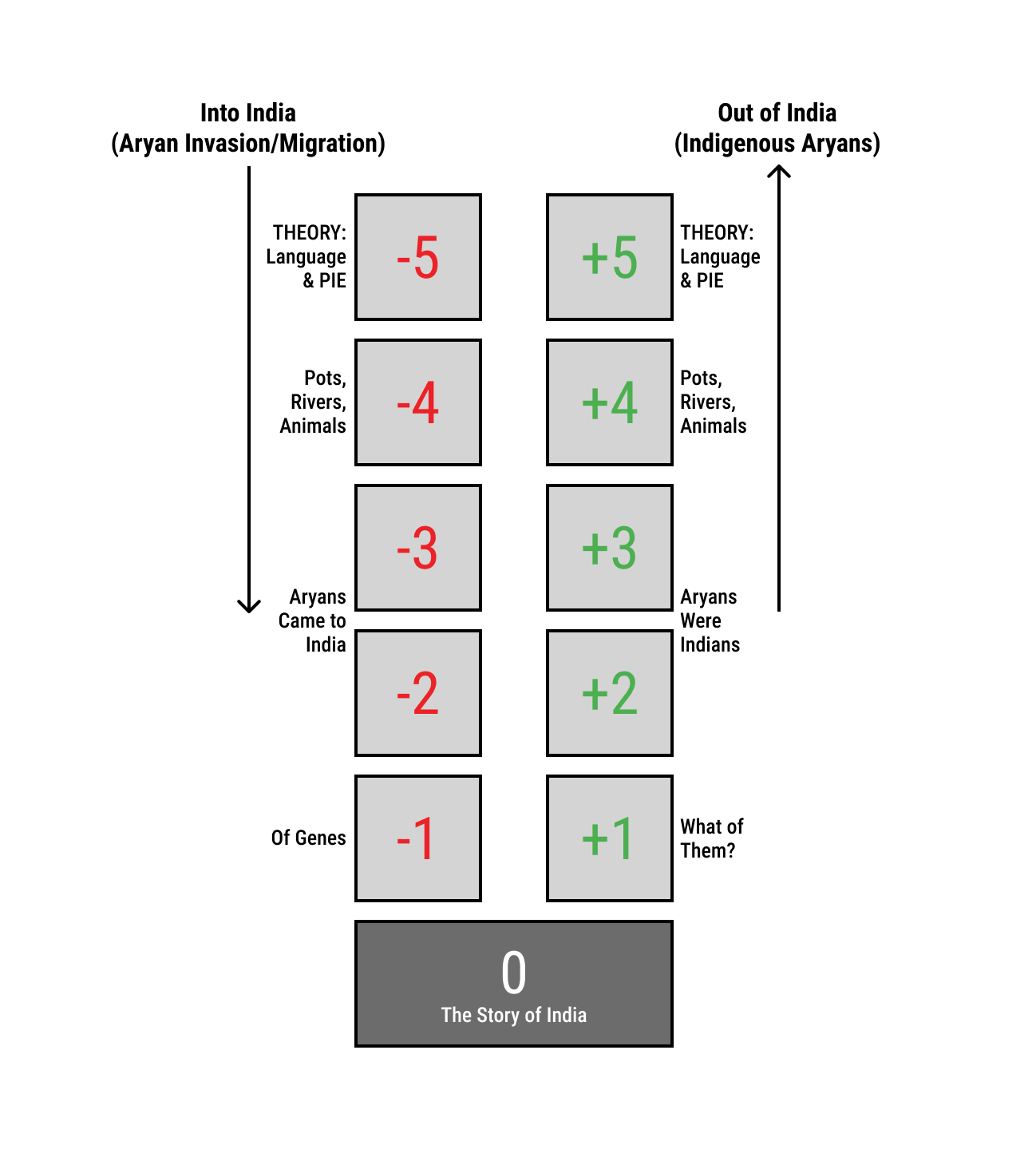
Who were the Aryans? What did they speak? When did they come into India, or was it leave India? In either case, what did they bring/take? What about that issue with horses, or chariots? And genetics has now proven it, no? What is it called now? Aryan invasion or migration? Or is it a trickling-in? Why do some people reject it, and how outrageous is the claim that Aryans went out of India?
Worry not, answers to these and more are laid along a simple axis from -5 to +5, as shown above.
At -5 is a base theory, the origin, which leads to 0 as an account of Aryan Invasion/Migration theory. It’s what THEY say happened.
Don’t shoot the messenger! I only parrot the message!
I do take liberty, though- so you will find much sarcasm -5 to -1!
But from 0 onwards, leading to +5, is the counter-response. The out-of-India theory. It’s actually simply OUR story. It just happens to have consequence on THEM, so it becomes out-of-India as a paradigm.
-5: The Base Theory
A science is born.
Languages connect to each other forming a family tree, and some language branches are more closely related than others.
We had this intuition for a while, even a myth of Babel, before we discovered uncanny similarities between Latin, Sanskrit, Greek and a few other languages. We looked closer, especially at Sanskrit- with its exhaustive literary corpus, rigorously defined grammar and highly-rooted etymology. Comparative Linguistics was born, and we saw that the Indo-European (IE) languages had all descended from a common mother language, which we nominally think of as proto-Indo-European (PIE).
And we claim:
We can know WHERE was PIE first spoken, WHEN it was spoken, WHO the people were that spoke it, WHAT their culture and religion were like, and HOW they dispersed and spread IE languages across Eurasia.
Even if there is debate on these issues, we know for sure that India was NOT the homeland. The PIE-speakers lived somewhere outside India, and at say 1500 BC, their linguistic descendants arrived in India, speaking Indo-Aryan (IA) language(s).
-4: Into India, Part A
Once upon a time, there was an invasion.
We found “vague memories” of an ancient homeland in the literature of the IA-speakers, or Aryans as they called themselves. They remembered names of rivers in far Afghanistan- Sarasvatī, Sarayū, Gomal- and called to Nature Gods for help against their enemies, the dark-skinned ones, Dāsas- which later became a generic word for servant. Quite on the nose these Aryans were.
For Dāsas were obviously the assortment of Dravidian, Austroasiatic and other language speakers that even now peopled the sub-continent. To not only conquer, but to keep conquered this vastness was no easy task. So their priestly elite- the brahmins- created a system of social hierarchy with themselves at the top, knowledge and authority preserved within, and descending only by birth. And we claim:
Craftily assimilating India’s animisms, careful to keep their cult at the core, restricting even the usage of their exclusive speech, they ensured their position there through socio-psychological institution. India’s masses, the Dāsas, were relegated to the bottom of the pyramid, forever fated there through hereditary disenfranchisement. It was an invasion complete, and thus did the language and culture of a foreign origin come to pervade India, sealing its future.
-3: Into India, Part B
Invasion proven, then recanted.
Come the 1920s, and mounds of the ancient past emerged at Harappa, at Mohenjodaro, and a hundred other places- a civilisation was discovered. Not an Aryan civilisation, not the Vedic civilisation. Advanced town planning, complex architecture and urban living. We kept digging, and it became apparent that as high as the civilisation rose, it met an eventual demise.
It was an obvious diagnosis. These were the Dāsa puras, this was the civilisation the Aryans invaded and conquered. Indra stood accused, and the archaeological proof to a linguistic theory was thus uncovered. Or was it? The timeline didn’t actually add up, and though Indra stood accused, what stood for his accusation? Where was the evidence of destruction? Where were the burial layers to evidence slaughter?
Turned out the civilisation had met its own death well prior to the Aryan arrival, induced in large part by the drying up of its primary river, the Ghaggar-Hakra. No, not the Sarasvati, that was in Afghanistan, remember? Anyway, we had to concede- there was no evidence of an invasion. No problem, we did still know that IA arrived in India, and came to dominate the culture and land nonetheless. A migration then, Aryan migration. From where, you ask? Ah, we still quibble on that, but most of us like to agree it was from the Steppe Grasslands. Roll with it.
But people refused to get it. Where was evidence of migration even, they would ask. We’d explain that the point wasn’t that. A single Aryan tribe, interning in Punjab during a harsh winter, could have transferred the IE cultural kit to the subcontinent.
Migration, trickling-in, tourism, accidental transfer- it doesn’t matter. The linguistic proof is there- an IA-speaking minority changed the cultural and demographic landscape of an entire subcontinent. And when people kept demanding archaeological evidence for linguistic truths, we had to remind them of a simple aphorism.
-2: Pots Don’t Speak
With linguistics and archaeology combined, presenting Indian history.
These Aryans, and even their Steppe forebears, were basic pastoral nomads. You know the kind- horsing about, praying to the Gods, kindling fires on elaborate altars, inventing chariots, a compulsion for stealing cattle. The last of these they described as gaviṣṭḥi, which roughly translates to ‘gau ki itch thii.’
It gave them an incredible wanderlust. Wandering nomadically, they interned at a Bronze Age civilisation, BMAC, before reaching Afghanistan. Beholding a majestic river, these Aryans found the strangest of reasons to quarrel. One group called the river Haraxvati, another called it Sarasvati. What one called ‘horse,’ the other named ‘sorhe.’ It was all very confusing, and they wisely decided to part ways before the conflict got out of hand. Those among these who made their way to India are the Indo-Aryans, and to secure their position atop the social pyramid, they conceived of a masterplan in (z)93 dimensions! It’s called the Caste System- the great Aryan hegemony.
You see, the model holds. There are no Steppe horse bones in India prior to 1500 BC, and we’re going to call the half-recovered wagon found in Steppe a chariot- so obviously chariots came to India from outside. We haven’t found fire altars in Harappan civilisation, and if we did we’d deny the evidence. We know that Harappan architecture used bricks, but the word brick- iṣṭaka- isn’t even found in the Ṛgveda! Is this not evidence that Aryans did not know Harappan cities? And the Indus script clearly associates to an early Dravidian, or maybe proto-Munda. But it could also be Language X. Even Language X is preferable to Sanskrit- which it absolutely cannot be.
The rest, of course, is history. With the caste system and its brahminic hege-
What? You have some questions? Sure…
Why are horse bones not preponderantly found in the record AFTER 1500 BC? We shouldn’t be expecting this, to be fair. Our model is a linguistic one, and there’s no guarantee that linguistic dispersals should have a material record. After all, pots don’t speak.
A chariot found in Sinauli, at 1900 BC? Or the Sintashta chariot is not a chariot? The Ṛgvedic chariot also refers to a wagon? Wait, what’s the point of all this? These are material facts, they have no bearing on comparative linguistics and linguistic palaeontology. Pots don’t speak. Stop right there! Don’t even think of fire-altars now, please! When we comparative linguists tell you that those archaeologists are wrong about their findings in Kalibangan, you must consider our authority. Pots don’t speak.
Huh? Aryans visited BMAC, and BMAC had bricks. But this doesn’t exclude BMAC from our narrative? What are you saying here? Absence of evidence is evidence of absence? Wait a minute, this is all too confusing. Please, just give it a rest.
Pots don’t speak :(
-1: But Genetics Does!
It’s hard science, don’t take it too hard.
Genes correlate far stronger to language, as is obvious. When a language from the Steppe arrives in India, we cannot be sure that pots and beads travel. But surely genetics do! Our linguistics being ‘hence proved’ at Base Theory level itself, we only need await yet to be found genetic evidence for the stamp of hard scientific proof to our truth!
In fact we can predict exactly how the evidence would look, and that is what true science does. It makes predictions, and comparative linguistics is a true science. So, if we can find evidence of gene travel from Steppe to India, somewhere around 1500 BC, hence proved! If we find evidence of this gene more in higher castes than in lower castes, hence proved! If we find it more in north Indians than in south Indians, hence proved!
And viola! Haplogroup R1a-Z93, a lineage that was in the Steppe once, made its entry into India near/after 1500 BC. R1a, starting from the Steppe, came to near-completely replace prior genetic lineages of Europe. Clearly R1a is the PIE-haplogroup, the genetic lineage of the first Aryan forebears.
R1a-Z93 is the Aryan gene. Even though Aryan is not a race, and we started with a purely linguistic matter. Go figure!
With limited ancient DNA data, convenient correlations and deliberate omissions, we find this Aryan gene more in higher castes than in lower castes. More among north Indians than among south Indians.
Genetics has given us proof of all we claimed in the preceding, so we are now ready to make our declaration.
0: A Story from Above
In ~1500 BC, a people with Steppe ancestry arrived in India, but don’t expect this to be materially evidenced. They spoke Indo-Aryan, which descended from Proto-Indo-European. Like their Indo-Iranian speaking cousins, they called themselves Aryans. To secure dominance for their language and culture among a demographic majority, they entrenched a self-serving caste hegemony.
The oppressed Dravidian, Austroasiatic and other non-IE speakers were natives of India, and at this point we don’t hesitate in conflating language with the pseudo-category of race. Oh, we forgot to add.
These Aryans also happened to preserve, document and create such an extensive linguistic and philological record, that we were able to learn from it and conceive of things like Comparative Linguistics and Proto-Indo-European.
What a journey from the nervous days of nascent linguistics, during which we even trekked with some pastoralists from Steppe to subcontinent!
But notice the collapsibility, the tautology:
A linguistic notion at first, itself not well defined and with bands of uncertainty.
An entire historical narrative for the Indian subcontinent, using the above linguistic notion and using the absence of material evidence as evidence of absence.
Tautological application of this narrative to Harappan archaeology, when it was discovered.
At the appearance of archaeological counters- revert to saying there is no reason to link archaeology with linguistics!
But the narrative does not disappear! Why?
Enter genetics. Suddenly language = race = culture = genes. Academics will tell us our history, it seems.
This appears nothing like our own impression of the past. Are we wrong then? Is beginning with theory and ending with story the correct way to do things? How would we know, if we do not try?We know our own story, and now from the above we know the theory to reach.
So let’s try the journey again, in reverse.
0: A Story to Below
We are a people with a deep past, indiscernibly deep. Sure, we have stories of migrations and invasions- just as much as we do of people migrating out.
On who or what were Āryas though, on whether our earliest Ārya ancestors came from outside, on what is Drāviḍa or Dāsa to us, we’ve never found reason to doubt our literature. But rarely, if ever, are Indians left to their stories. It seems important to challenge them and create false ones. Well, it became commensurately important we respond. So we looked.
Guess what we found?
Linguistic and philological evidence establishes India as the most likely PIE homeland. We make no further claims- our claim is linguistic alone. But you haven’t left it linguistic alone, have you? So we must trek the same journey back.
Let’s go.
+1: It’s Not Rocket Science
It’s just genetics, why do you struggle so much?
Very good, you found the Aryan gene. Pray, tell- why isn’t R1a-Z93 found in Zoroashtrian priests or Mycenean Greeks? Or, did R1a originate in the Steppe? No? Where then? We have raw genetic data, yes. But what is it evidence of? Think it through, it’s not rocket science.
How is R1a found among some non-IA speakers, or non-R1a among IA speakers? Why do some “lower castes” have R1a, and why do they have any shared genetics with “upper castes?” Why are “south Indian” genes found in India’s northern inhabitants, and why are “north Indian” genes among those of the southern states? With a dazzlingly-branching genetic tapestry in the human past, why is a specific genetic ripple at ~1500 BC (if that) so all-salient? Take your time parsing through the many papers available, don’t be daunted.
It’s not rocket science.
Or confront India’s position as humanity’s second primordial homeland- outside of Africa. Her contribution to formative ancestries of Oceania and Japan. Haplogroup D, going to East Asia. Paternal lineages H and K*, their origins here. The ancestry of R- which leads to haplogroup P with origins in India. Haplogroup O of the Pearl River Delta, origins in the Eastern Himalaya. Ranging temporally to the Last Glacial Maximum ~28kya, notice India’s unique position for ethnogenesis around climatic bottlenecks. Add to this the emerging linguistic relationships between PIE and Tibeto-Burman. If India is humanity’s second primordial homeland, genetically, surely it is also a primordial homeland linguistically? But we won’t make this claim. Why? Because linguistics and genetics do not flow the same. You think it hence proved even if tautologically, but this correlation needs proof as teleology. Why do you find it so hard? After all…
It’s not rocket science.
+2: Pots Don’t Speak, But Facts Do
Or, cultivating discernment and clarity.
A tautological truth- the Steppe variety of horse was not known to Indians before the Steppe variety of horse was brought to India. But India was familiar to the equid in general, proven even in the doodles of our cavemen ancestors. The Aryans used aśva for any quick animal, including non-equid varieties, proven in literature. Aśva as the “true horse” in specific is not found in the entire early Ṛgveda. Without resolution of these, no association with Steppe or PIE can be made on account of horses.
Similar problems occur with the ‘ratha,’ being a wagon at several places in the Ṛgveda. Account for Sinauli, 1900 BC, and defend Sintashta to the chariot experts. If fire-altars are a PIE thing, where be the archaeological evidence for continuities of geometry, brick-construction, and architecture? Argue to let linguistic findings lead linguistic conclusions, if only Kalibangan’s archaeological findings can be led by archaeological conclusions. If pots don’t speak, don’t speak of pots.
In truth, the two ends of our axis tend to the same assertion- the matter is linguistic alone, and pots cannot speak on linguistic matters. We accept migrations- into India and out of it, across time. Or genetic data, for a migration is but the dispersal of genes.
But peeling away layers that conflate and (mis)compound, we’re left with a simple question- leaving Sanskrit aside (only for a moment, that is), what exactly did some Steppe horse-riders bring to India? Turns out we have a theory too. And then some.
+3: Out of India, Part A
Indian life, as discernible in record.
Put aside the exceptions raised above. The domesticated horse, and the true chariot, are speculated to have emerged in latter phases of PIE disintegration and dispersal. In a fascinating turnaround of events, for the PIE homeland to be in India, we need not the domestication of horse here, nor even PIE in an integrated state at the time of true chariot invention. We never did.
But we need account for issues of cow and mouse. The ancient Indians were being honest when they said ‘gau ki itch thii,’ except that the itch was to take the cows out from here! Genetic evidence on bos indicus indicates no admixture from outside India, but bos indicus admixture is found in as far as Ukraine and Turkey. The domesticated cow is not a creature of wanderlust, it bounds thus far under human yoke. In other words, unmistakably did Indians migrate out of India, with the material evidence to show for it. What proves they spoke IE languages? Patience, we’ll get there too. For now, add to your bearing that the domesticated mouse evolved in India. Not nomadic by a long shot, it spread across the planet with human trails.
Organised agriculture. Metallurgical trajectories to Bronze Age and beyond. Material, technological, architectural and aesthetic lines of development from at least 7000 BC. Harappan ratio bricks found 4000 years before it at Mehrgarh, or at Kunal. Pashupati seals, yogic postures, svastikā symbols. No break in the Indian skeletal record after 4500 BC.
Continuities, continuities, continuities. The Harappan civilisation is your academic category, not a discernible reality. The reality is Indian civilisation, and it flows like the Sarasvatī. Speaking of which, one needs understanding of the Sarasvatī significance? Here’s the claim, onus on you to disprove.
The Sarasvatī and the Ghaggar-Hakra are one and the same. Consequently, Haraxvati- or the Helmand- was named later. See the arrow?
Points from India, out.
+4: Out of India, Part B
Two can play the game, here’s how we win.
First, the basics. Obviously there were languages spoken in India long before Sanskrit emerged. While we may accept current classifications for IE, Dravidian, Austroasiatic and other languages, no linguistic compulsion exists for hard boundaries that restrict inquiries upon the established paradigm. Already there are whispers of Nostratic, and we may only hope your instinct isn’t to go running for the Nostratic gene.
Now, the linguistics. No need for Dravidian evidence in other IE branches, for PIE homeland in India to be plausible. Just like there is no need for Finno-Ugric evidence in other IE branches, for PIE homeland in Steppe to be plausible. Two can play the game, and we’ve caught on to it. Dravidian influence in IA cannot be impugned substratum a priori- here the game’s up. When comparative linguistics is conducted without a priori filters, gear up to recalibrate once Tibeto-Burman and PIE relationships are better understood. Also, and this is no light matter, you’ll have to give a better cope for the Preservation Principle than did Mallory :)
But it’s not about what we want. This is about what you want. You want a model allowing archaic dispersal for proto-Anatolian? We have it. Need Tocharian next, so that your latest satem-centum mandates are satisfied? Check. A model for dispersal of Western IE languages, and temporal restriction that this happen prior to invention of chariot? You got it, this is too easy. And the next part is the most fun, for on dispersal of Eastern IE languages is where things get clinched.
So finally, the philology. Early Ṛgveda, later Ṛgveda- Oldenburg 101? Your game, we’re just playing it. And what’s that thing about not hating the player, hating the game? Geography, flora, fauna, hydronomy- early vs. later Ṛgveda. Take a look, try to refute. Better still, try something other than Jahnāvī. Or maybe there’s hope, and you see the arrow.
Points out, from India.
Bhalāna, Pāktha, Pārthava, Pārśava, Dāsa, Ālina, Viṣāṇin, Simyu, Druhyu, Bhṛgu, Danu, Kavi, Auśinara.
How many names are needed to pick up the trail of IE languages as they dispersed out of India and reached their eventual habitats? And what is to be done about the fact that the speakers of the final 5 IE branches are found chilling near the Rāvi River of Punjab, in the Ṛgveda?
Foul, you cry.
Folk etymology, your scholars decry.
Understandable, we reply.
Cognitive dissonance yields desperate cope.
We give you rope.
Remove them all, explain just the Dāsas, Pārthavas, Pārśavas. Or you know- Dahae, Parthians, Persians- Iranians? What were these dudes doing in Punjab? Hadn’t they split at that Helmand fiasco back in Afghanistan? If they were in Punjab, that means the-
Arrow.
Points.
Out.
Oh wait, suddenly the entire model has collapsed. Worry not, here’s the rescue, for we can finally see emerge:
+5: The Based Theory
Or out-of-India, but why bother naming a collapsed house of cards.
It’s really just simple truths at this stage, if you’ve kept up. Languages transmit and flow somewhat similar to genes, but not always. When do they, and when not? How much, or how less? Can’t be said.
PIE is a fair hypothesis, but its spot and nature in the language family tree is far from certain. So uncertain in fact, that it simply cannot be construed as a “real and spoken” language of a time. It has no spatiotemporal reality, only a nominal existence as relative milestone in the language stream. More importantly- as a nominal construct without spatiotemporal bearing, there’s no rationale to associate with it cultural and religious origins of any kind. What could have descended from PIE to IE, could also have come to PIE from proto-PIE. Funny how slippery the slope is.
Why take it from us, take it from Mallory, a master of PIE and PIE reconstructions-
“A solution to the IE problem will more than likely be as dependent on a re-examination of the methodology and terminology involved as much as on the actual data themselves.”
Such and other re-examinations may yet force reconsideration of boxes like IE, Dravidian, Tibeto-Burman, Aryan, and others. How will bearings be retained then, if the linguistic ground underneath shifts and shakes, but hard fastenings to genetics, archaeology and more have already been committed to?
And of course, no Indian today is permitted historical re-examination unless the Caste System is explained. Did the linguists actually tell us what IE origins and dispersal have to do with caste? Or did they simply fit it in, building on the fly? Well, let’s lay it out. Let’s talk about varṇa and jāti. About kula and gotra. About the Puruṣa Sūkta if you like. And let’s also talk time-depths.
PIE disintegrated and dispersed in multiple waves, spread out over centuries, right? Did the Caste System originate in a day, in a month, in a year, in a century, or more? What came first- varṇa or jāti? What was the earliest rigidity- upwards mobility or birth-based-binding? Did the Aryans conceive of the hegemony when they were in the Steppe, or after settling down in India? If the latter, what aspect of the IE Cultural Kit were they drawing from? If it wasn’t from the IE Cultural Kit, then surely it was something in India itself?
You see, the great illusion of the first 5 steps is precisely this. Convoluted, reductive and over-simplified narratives built to uphold a linguistic theory so shaky, certitudes are rarely substantial. To yank at these pillars, to cause their easy collapse, is not to make the denials we’re accused to making. We can talk about migrations and genetics, no problem. We can talk about India’s social inequities, no problem. Let’s discuss the caste system, and let’s also discuss it with our own etymology and ontology. Where and how these become salient upon PIE origins- no amount of steps can explain. India was home to many migrations and countless genetic lineages. It was home to several endogamies and hundreds of community boundaries. It was simply home:
To Indians.
To Indian languages and Indian culture.
To Indian agriculture, Indian metallurgy, Indian architecture and Indian art.
It was a civilisation with continuity, diversity and integrity, self aware enough to consider Sanskrit and Tamil its two great eyes.
Do share again that thing you said, Aryan vs. Dravidians what?
Sorry, we can’t hear you.
There you go, a look at theory-to-story, story-to-theory, between the 2 same theoretical and narrative constructs.
-5 and +5 are not too much in disagreement. Both are ready to work within a PIE model, and both can be persuaded to be open on the homeland question. But -5 wants to exclude one homeland in particular, which happens to be the same that +5 finds enough case for.
-4 and +4 both deal with linguistics. Since they broadly agree at step |5|, they share frameworks and do not conflict there. They conflict on conclusions, which is to say on the story that’s formed. To obfuscate this,
-3 and -2 indulge in a heavy bout of tautologies, roundabouts and red herrings. If that’s the game, +2 and +3 are happy to play it. Just gets us nowhere, since -3 and -2 have easy fallbacks to -5. But they would much rather double down,
And exult triumphant at -1. But only two steps ahead of that comes the undoing at +1.
So the real loggerhead is not at |5|, |4|, |3|, |2| or |1|, it’s at 0- at the Story.
Remember this next time you talk to a SteppeBro (or Sis). Make note of which step they sit at, and approach accordingly. They play a slippery game, but they’re counting on you not knowing this.
Epilogue for the Troubled Mind
But! Isn’t it an incredible wanderlust those ancient Indians must have had? To leave India in such droves?
That’s a great question, one we wonder too. Isn’t it an incredible wanderlust those ancient SteppeLords must have had? To flee the grasslands in all directions?
But! Isn’t the IE invasion of Europe corroborated by archaeological and genetic proof? Its ethnolinguistic landscape was completely changed by SteppeLords, wasn’t it?
Absolutely it was, which is why we know the Steppe to have been at least one point of dispersal. In the linguistic model, it’s what’s called the second center of linguistic innovation, where the original zone of innovation has been left behind and is no longer in contact. More specifically, Steppe was the launching area for Western IE languages, after their predecessor had long left India.
But! What is the problem with migrations? Ultimately we all come from Africa, no? So why do you have to be in denial?
We don’t have to be in denial, and we aren’t. You sound like you need to start at -5 again. Do consider.
But! India has accepted and assimilated so many cultures/religions of foreign origin? Why is it so disagreeable that Hinduism and Sanskrit could also have come from outside?
It’s not disagreeable, and that’s not why we disagree. Are we going to have to answer a broken record now?
Okay last, last. But! Genetics?
…